

Automatic Gates vs. Manual Gates: Pros and Cons
Choosing the right gate for your property is an important decision that affects both security and convenience. Whether you’re considering an automatic gate or a manual gate, each type has its advantages and disadvantages. This article will explore the pros and cons of automatic gates vs. manual gates to help you make an informed decision for your home or business.
Automatic Gates
Automatic gates, as the name suggests, operate with the push of a button or through sensors, remote controls, or keypads. They are becoming increasingly popular due to their convenience and advanced security features.
Pros of Automatic Gates
Convenience: One of the biggest advantages of automatic gates is the convenience they offer. You can open and close the gate without having to leave your vehicle, which is particularly beneficial in bad weather or when you are in a hurry.
Enhanced Security: Automatic gates often come with advanced security features such as access control systems, intercoms, and cameras. These features allow you to monitor and control who enters your property, providing an additional layer of security.
Increased Property Value: Installing an automatic gate can increase the value of your property. They are seen as a luxury feature that enhances the overall appeal of your home or business. Potential buyers often appreciate the added security and convenience.
Customization: Automatic gates come in a variety of designs, materials, and finishes. This means you can choose a gate that matches the aesthetic of your property while also meeting your functional needs.
Safety Features: Many automatic gates are equipped with safety features such as sensors that prevent the gate from closing if an object or person is in the way. This helps to prevent accidents and injuries.
Cons of Automatic Gates
Higher Cost: Automatic gates are generally more expensive to install and maintain than manual gates. The cost includes the gate itself, the automation system, and any additional security features.
Maintenance and Repairs: Automatic gates require regular maintenance to ensure they function correctly. This can include checking the motor, sensors, and other components. Additionally, repairs can be costly if the automation system fails.
Power Dependency: Automatic gates rely on electricity to operate. In the event of a power outage, the gate may not function unless it has a backup power source, such as a battery or generator.
Installation Complexity: Installing an automatic gate is more complex and time-consuming than installing a manual gate. It often requires professional installation to ensure all components are properly set up and functioning.
Manual Gates
Manual gates operate without any electronic assistance. They need to be opened and closed by hand, which is how gates have traditionally been used for centuries.
Pros of Manual Gates
Lower Cost: Manual gates are typically less expensive to purchase and install compared to automatic gates. They don’t require any electronic components, which reduces the overall cost.
Simplicity: The simplicity of manual gates is one of their main advantages. There are no electronic parts that can fail, which means fewer maintenance issues and repairs.
No Power Needed: Manual gates do not require electricity to operate, so they are unaffected by power outages. This makes them reliable in all situations.
Easy Installation: Installing a manual gate is generally straightforward and can often be done without professional help. This makes them a good choice for DIY enthusiasts.
Cons of Manual Gates
Less Convenient: The main disadvantage of manual gates is the lack of convenience. You need to physically open and close the gate, which can be time-consuming and inconvenient, especially in bad weather or when you are in a hurry.
Security Limitations: Manual gates do not offer the same level of security as automatic gates. Without advanced access control systems, it is easier for unauthorized individuals to gain entry to your property.
Physical Effort: Opening and closing a manual gate requires physical effort, which can be challenging for individuals with mobility issues or those who are not physically strong.
Limited Features: Manual gates typically lack the advanced features found in automatic gates, such as remote access, intercom systems, and integrated cameras. This limits their functionality and the level of control you have over access to your property.
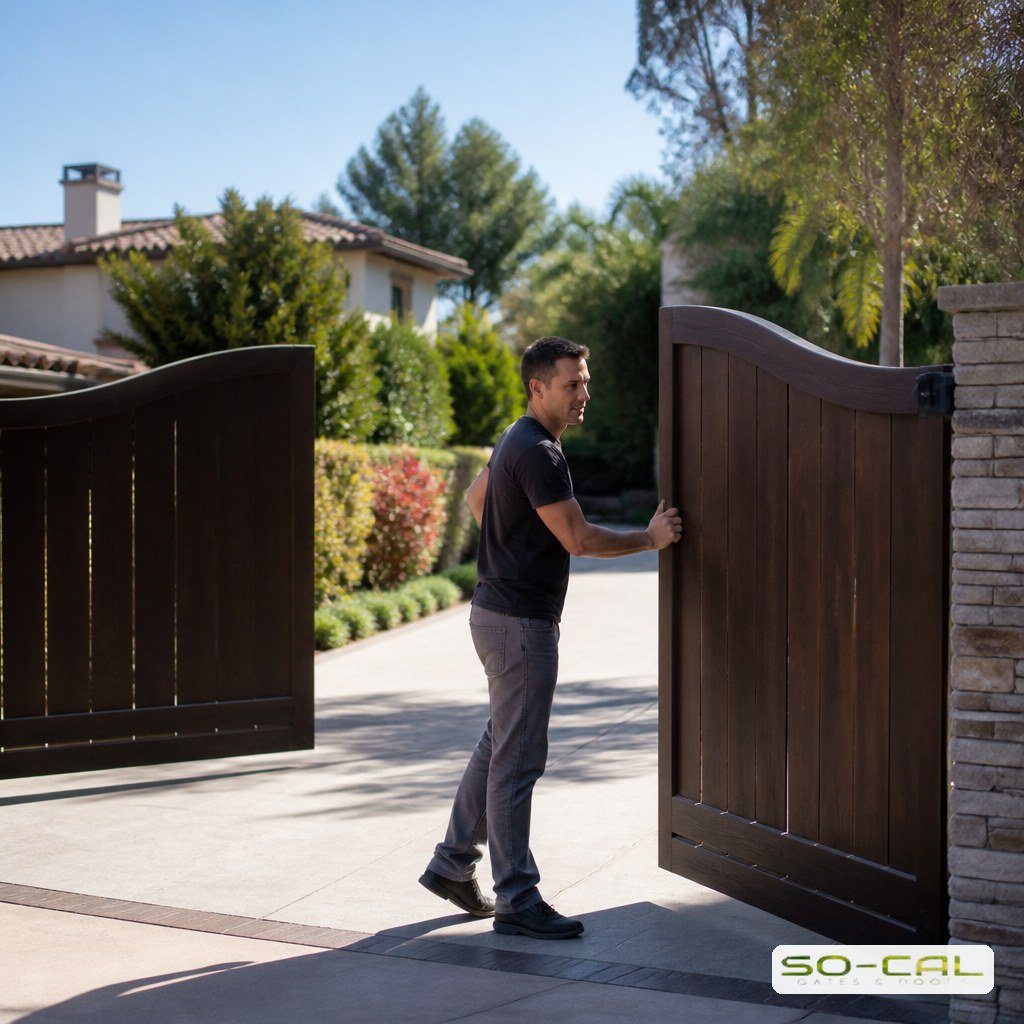
Factors to Consider When Choosing Between Automatic and Manual Gates
Purpose: Consider the primary purpose of the gate. If security is your main concern, an automatic gate with advanced security features may be the best choice. If you are looking for a simple barrier, a manual gate may suffice.
Budget: Your budget will play a significant role in your decision. Automatic gates are more expensive, both in terms of initial cost and ongoing maintenance. Manual gates are more budget-friendly but may lack some desired features.
Convenience: Think about how often you will use the gate and how important convenience is to you. If you frequently enter and exit your property, the convenience of an automatic gate might outweigh the higher cost.
Maintenance: Consider how much time and money you are willing to invest in maintaining your gate. Automatic gates require more maintenance, while manual gates are simpler and require less upkeep.
Aesthetic Preferences: The appearance of the gate is also important. Both automatic and manual gates come in various styles and materials, so you can choose one that complements your property’s aesthetic.
Automatic Gates vs. Manual Gates: The Real Cost of Ownership
The purchase price is the part everyone compares, and it is the part that matters least over a decade of use. The more useful comparison is what each type costs you to keep working, because that is where the two genuinely diverge.
What an Automated Gate Costs to Run
The running cost of an automatic gate is made up of four things: electricity, annual servicing, wear items, and the eventual replacement of the operator. Electricity is negligible. Servicing and wear items are modest and predictable. The operator is the significant one, and how long it lasts depends almost entirely on whether it was sized correctly for the gate and the traffic in the first place.
The Components That Actually Wear
Only a handful of parts on an automated gate are genuinely consumable, and knowing which ones makes the long-term budget far easier to predict.
Rollers, Hinges and Safety Sensors
These are the inexpensive, regularly serviced items. Rollers and hinges wear steadily and are cheap to replace. Safety sensors do not so much wear out as drift out of alignment and collect dust, which is a cleaning and adjustment job rather than a parts job. Between them these account for most routine service visits and very little of the lifetime cost.
The Operator and Control Board
This is the expensive component and the one with a finite life measured in cycles rather than years. A correctly sized operator on a residential driveway lasts a long time. The same unit asked to run a heavier gate, or a far busier entrance than it was rated for, spends its whole life at maximum load and fails early. Sizing at specification is the decision that quietly determines this cost.
Why Local Conditions Shorten These Intervals
Inland Empire conditions are harder on an automated gate than the manufacturer’s generic schedule assumes. Fine dust settles continuously on sensor lenses and in tracks, and the daily temperature swing dries out lubricant and shifts clearances faster than in milder climates. Gates here genuinely benefit from more frequent attention, and almost all of that attention is cleaning, lubrication and alignment rather than parts.
Repair and Maintenance: What Changes When a Gate Is Automated
A manual gate has two things that can go wrong: the hinges and the latch. Both are visible, both are cheap, and either can usually wait until the weekend. Automating the same gate adds a motor, a control board, safety sensors, wiring and a manual release, and each of those introduces a failure mode that a manual gate simply does not have.
That is not an argument against automation. It is an argument for treating an automated gate as a system with a service schedule rather than as a gate with a motor attached. The households that get ten trouble-free years out of an automated gate are the ones having it looked at once a year; the ones replacing operators every few years are usually the ones who called only when it stopped.
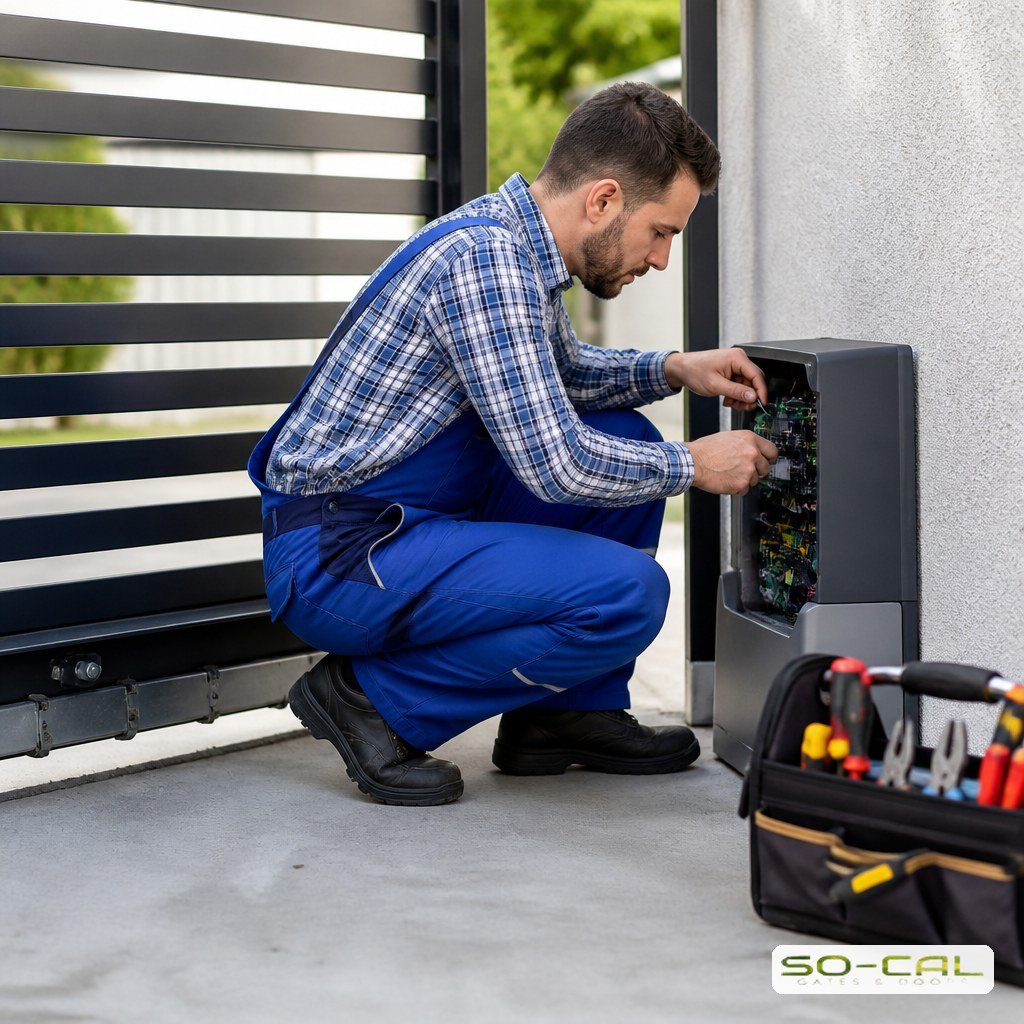
The practical signals are worth knowing. A gate that has become slower, noisier, or that hesitates at the same point in its travel is telling you something mechanical needs attention, and addressing it early is what stops a cheap adjustment turning into an operator replacement. A gate that reverses without an obvious obstruction usually needs its sensors cleaned or realigned rather than anything more serious. If yours is showing either, professional gate opener installation and service will diagnose the cause rather than replacing parts speculatively — and on a busier entrance the same logic applies to commercial gate repair, where duty cycle rather than age is usually what has driven the failure.
Conclusion
Both automatic and manual gates have their own set of advantages and disadvantages. Your choice will depend on your specific needs, budget, and preferences. Automatic gates offer superior convenience and security but come at a higher cost and require more maintenance. Manual gates are more affordable and simpler but lack the advanced features and convenience of automatic gates.
Get Automatic or Manual Gate Installation Services in Riverside from Us
If you’re considering installing a gate on your property, whether automatic or manual, we can help. Our professional team in Riverside offers expert installation services tailored to your specific needs. We provide high-quality gates and ensure they are installed correctly and efficiently. Contact us today to discuss your requirements and get the best gate solution for your home or business.
Frequently Asked Questions
Are automatic gates worth the extra cost?
It depends on how often you use the gate and what you need from it. On an entrance used several times a day, or where access control and security matter, the convenience and control usually justify the difference. On a gate opened once a week purely as a boundary marker, a manual gate does the same job for considerably less.
What happens to an automatic gate during a power outage?
Every automated gate has a manual release that disengages the drive so the gate can be moved by hand. Many installations also carry a battery backup that keeps the gate working normally through a short outage. It is worth knowing where your release is and how it operates before you actually need it.
How often does an automatic gate need servicing?
Once a year suits most residential installations, and more often on a busy or commercial entrance. A proper visit covers safety sensor testing, roller and hinge condition, drive alignment, manual release operation, and the operator’s force settings. Most expensive failures are the end point of a problem an annual check would have caught.
Can a manual gate be automated later?
Often yes, provided the gate and posts can take it. Automation adds weight and load, so the frame needs to be rigid enough and the posts and footings substantial enough to carry an operator. An existing gate should be assessed before an operator is specified, because reinforcing a frame afterwards costs more than building for it from the start.
Which type is more secure?
An automatic gate is generally the stronger deterrent, because the drive holds it closed and it can be integrated with keypads, intercoms and cameras. That advantage only holds if the rest of the perimeter matches it, though. A well-specified gate beside a low fence or an open side access simply moves the easiest route rather than closing it.
Do automatic gates add value to a property?
They are widely seen as a desirable feature, particularly where security and privacy matter to buyers. The effect depends heavily on condition: a well-maintained gate that operates smoothly reads as an asset, while one that is visibly struggling reads as a repair bill waiting to happen.