

How Does a Sliding Gate Work? The Mechanics Explained
A sliding gate makes a heavy barrier disappear sideways instead of swinging into your driveway, which is why it has become the default choice on properties where space is tight or the ground slopes. But how does a sliding gate work once you look past the remote control? The answer comes down to four systems working together: what the gate rides on, what pushes it, what powers that, and what stops it when something is in the way. Understanding each one makes it far easier to specify a gate that lasts, and to recognize early when something is starting to go wrong.
How Does a Sliding Gate Work in Practice
Every sliding gate is a heavy panel that has to travel in a straight line, stay upright, and stop precisely. The engineering challenge is not the movement itself but doing it repeatedly, for years, while carrying several hundred pounds through heat, dust and wind. The design choices below all exist to solve that problem in different site conditions.
Two decisions shape everything else: how the gate is supported, and how it is driven. Get those right for your property and the rest of the system is straightforward. Get them wrong and you will be dealing with binding, sagging or premature motor failure regardless of how good the components are.
The Track and Roller System
The support system carries the entire weight of the gate and determines how smoothly it travels. This is the part homeowners rarely think about and the part that causes the majority of long-term problems, because it is the only component in constant physical contact with the ground or the frame.
V-Track Versus Cantilever
There are two dominant approaches, and they are genuinely different products rather than variations on a theme. Which one suits your property depends almost entirely on your driveway surface and how much room you have alongside the opening.
V-Track: Ground-Mounted and Simple
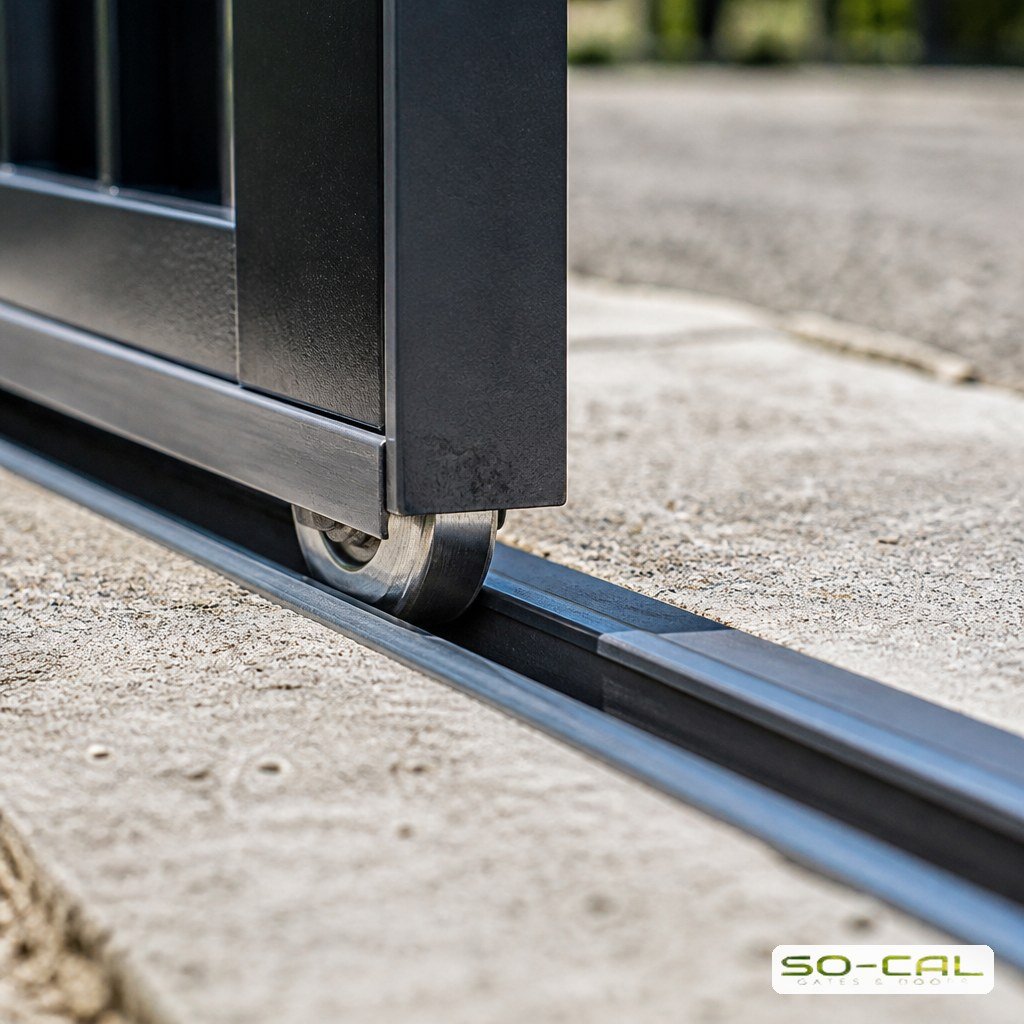
A V-track gate rides on steel wheels that sit in a V-shaped rail fixed to the driveway. The weight goes straight down into the ground, which makes the system mechanically simple, relatively inexpensive, and capable of carrying very heavy gates. The trade-off is the track itself: it collects dirt, gravel and leaves, and anything sitting in the groove will make the gate jump, bind or stall. It also needs a level, well-drained run to work properly.
Cantilever: No Ground Track at All
A cantilever gate carries its weight on roller assemblies mounted to posts beside the opening, and the gate hangs from them with nothing crossing the driveway. Because there is no ground rail, there is nothing to clog, nothing to trip over, and nothing to fill with debris. The cost is space: a cantilever needs a counterbalance section roughly half the length of the opening again, so you need clear run-back alongside the gate.
Why Cantilever Usually Wins on Uneven Driveways
On a sloped, cracked or seasonally shifting driveway, a ground track is a maintenance problem waiting to happen, because the rail has to stay straight and level and the ground underneath it will not cooperate. A cantilever sidesteps that entirely by never touching the driveway surface. Many Inland Empire properties sit on ground that moves enough over a few summers to pull a V-track out of alignment, which is why cantilever installations have become the more common recommendation here despite the extra space they demand.
The Drive Mechanism
Once the gate is supported, something has to move it. The drive is the link between the motor and the gate leaf, and it determines how smoothly the gate accelerates, how quietly it runs, and how it behaves under load.
Chain Drive Versus Rack-and-Pinion
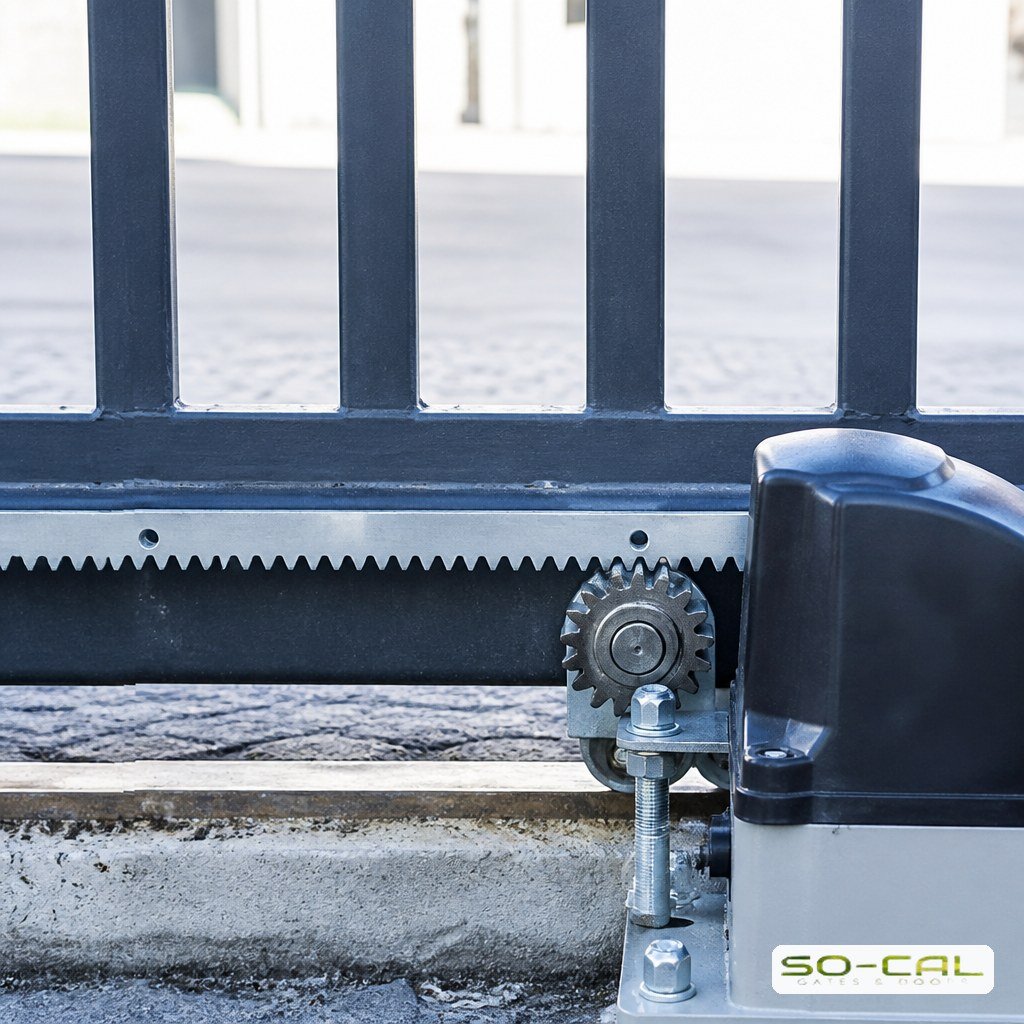
A chain drive pulls the gate along using a chain anchored at both ends, which is inexpensive and tolerant of rough alignment but tends to be noisier and stretches over time. Rack-and-pinion uses a toothed rack bolted along the gate frame that meshes with a gear on the operator, giving smoother, quieter and more precise movement, with better control at the start and end of travel. Most quality residential and commercial installations today use rack-and-pinion, and correcting a stretched or misaligned rack is a routine part of professional sliding gate installation and service.
The Operator and What Sizing Really Means
The operator is the motor and control unit that drives the gate, and it is rated by gate weight, gate length and duty cycle. Duty cycle is the part people overlook: it describes how many times per hour the unit can run without overheating, and it is the difference between a gate that lasts a decade and one that fails in two years.
A residential-rated operator on a single-family driveway that opens six times a day is a comfortable match. The same unit on a shared entrance opening two hundred times a day is being asked to do a job it was never rated for, and it will fail early and often. Weight matters just as much: an undersized motor on a heavy gate spends its whole life at maximum load. Correct sizing at the specification stage is quiet, invisible work, and it is the single decision that most determines how long the whole system lasts, which is why professional gate opener installation starts with measuring rather than with a catalog.
Most operators also include a manual release so the gate can be moved by hand when the power is out. On a sliding gate this matters more than on a swing gate, because a heavy panel sitting in a track is not something you can simply push aside without disengaging the drive first.
Safety Components That Are Not Optional
A sliding gate moves sideways across an opening, which creates hazards a swing gate does not have. The leading edge travels toward a fixed post, and the whole length of the gate passes the opening as it moves. Both create places where a person, pet or vehicle can be caught, and both are addressed by required safety equipment rather than by careful driving.
Photoelectric sensors project a beam across the opening and reverse the gate the moment it is broken, before any contact happens. Contact edge sensors run along the leading edge and reverse on touch, catching the cases a beam geometry can miss. Both back up the operator’s own ability to detect that it has hit resistance. Together they form the layered protection that a compliant installation is built around.
These components need attention, not just installation. Dust films over sensor lenses, mounting brackets shift slightly as metal expands and contracts through the season, and a gate that has started reversing for no obvious reason is almost always telling you a sensor needs cleaning or realignment. Rollers need the same care: worn or seized wheels are the most common cause of a sliding gate that has become noisy or sluggish, and replacing them is far cheaper than replacing a motor that has been straining against them. Routine roller service and replacement is the maintenance item with the best return on a sliding gate.
Conclusion: Four Systems, One Gate
A sliding gate works by combining a support system that carries the weight, a drive that moves it, an operator sized to the real workload, and safety devices that stop it before it causes harm. Problems almost always trace back to one of those four, and knowing which one turns a vague complaint into a specific, affordable fix. If your sliding gate has become noisy, slow, or is reversing without reason, or you are planning a new installation and want it sized correctly the first time, call SO-CAL Gates & Doors for a free assessment anywhere in Riverside, Corona and the surrounding area.
Frequently Asked Questions
How long should a sliding gate last?
A well-specified sliding gate frame lasts decades, while the moving parts have shorter lives. Rollers are usually the first to need replacement, followed by the operator, whose lifespan depends heavily on whether it was sized for the actual traffic. Gates that fail early almost always turn out to have been under-specified rather than badly built.
Why has my sliding gate become noisy?
Noise nearly always comes from the support system. On a V-track gate the usual causes are debris in the rail or worn roller wheels; on a cantilever the roller assemblies themselves need attention. Grinding or scraping should be looked at promptly, because a gate fighting its own rollers puts continuous extra load on the motor.
Is a cantilever gate better than a V-track gate?
Neither is universally better. V-track carries more weight for less money and suits a level, well-drained driveway. Cantilever costs more and needs extra room alongside the opening, but it never touches the ground, so it is the stronger choice on sloped, cracked or shifting driveways. The site usually makes the decision rather than the budget.
What happens to a sliding gate in a power outage?
Every automated sliding gate should have a manual release that disengages the drive so the gate can be moved by hand. Knowing where yours is and how it operates before you need it is worth a few minutes. Many installations also carry a battery backup that keeps the gate working through a short outage.
How often does a sliding gate need servicing?
Once a year is a sensible baseline, and more often on a busy entrance. A proper service covers roller condition and alignment, track cleaning where one exists, drive tension or rack engagement, safety sensor testing, and manual release operation. Most expensive sliding gate failures are the end of a slow problem that an annual visit would have caught.
Can a sliding gate be installed on a sloped driveway?
Usually yes, but the slope shapes the design. A ground track needs a level run, so significant slope across the opening points toward a cantilever, which carries its weight on posts and is unaffected by the driveway surface. An on-site assessment is what determines which approach your property can actually take.