

Garage Door and Gate on One Property: What Carries Over
A garage door and gate on the same Riverside lot share radio spectrum, one safety standard and a power outage. Federal garage-door safety rules reach only the door; wiring and credentials differ. Choose how one credential opens both receivers before deciding what hardware to add.
What a Garage Door and Gate Actually Share
The honest list is short, and most of it is electrical. Both machines are electric operators covered by one document — ANSI/CAN/UL 325, the Standard for Safety for Door, Drapery, Gate, Louver, and Window Operators and Systems. Sharing a cover page is not sharing a chapter. A residential garage door operator and a vehicular gate operator are handled separately inside it; the gate operator’s entrapment requirements sit in section 32.
One radio neighborhood, two separate conversations
Both hand-held transmitters are unlicensed Part 15 devices under the same FCC rule. Section 15.231 restricts that class of radio to a control signal of the sort used with alarm systems, door openers and remote switches, and its field-strength table carries a row for 260 to 470 MHz. One table row is the entire extent of the sharing. Sharing a band is not sharing a language, and that one confusion sells the second transmitter nobody needed.
One open input, and why the relay lands at the gate
The gate end is built to take outside hardware. One gate operator manual wires a keypad, card reader or key switch to its normal-opening input as a dry, normally open contact. A current-generation garage head unit may offer no equivalent. Its wall-control terminals belong to the maker’s own controls: one owner’s manual allows up to two smart control panels or four other door controls on its protocol, and states that older door controls from that maker and third-party products are not compatible. So the added hardware goes at the gate: a receiver, a relay, two conductors into the operator’s cabinet at the end of the driveway, and nothing new inside the garage.
Two Barriers, Two Different Rule Books
Here the shared-problem assumption starts doing damage. The garage door operator is regulated by name in federal consumer product law, with figures you can take on site with a tape measure and a stopwatch. The gate operator is not in that law at all.
The garage door answers to a federal rule with numbers in it
16 CFR Part 1211 applies to all residential garage door operators manufactured on or after January 1, 1993 for sale in the United States. Past the first foot of travel down from the upmost position, a downward-moving residential garage door must begin reversing within two seconds of contact with an obstruction. For secondary protection on a vertically moving door, the rule gives three alternative routes rather than one: constant pressure on a line-of-sight control with any supplied transmitter limited to opening only, a means for connection of an external secondary entrapment protection device, or an inherent secondary device on a combination sectional overhead system.
California Health and Safety Code 19890(b) additionally requires an edge, optical sensor or similar device for operation. The familiar six-inch figure is not in that regulation. It comes from the operator manufacturer’s installation instructions, restated in DASMA Technical Data Sheet 364, which has each photoelectric eye lens — the lowest lenses where there is an array — emit its beam no higher than six inches above the garage floor. That is a photoelectric figure only: a contact edge rides the bottom section and travels with it, so no floor height applies to it. Eyes raised to clear the stored boxes break the instruction sheet, which California Health and Safety Code 19890(d) requires anyone installing or servicing an opener to follow.
The gate sits outside that rule, and in 2024 the text said so
When the Consumer Product Safety Commission amended Part 1211 in 2024, it struck a stray reference to a gate opening and another to a swinging gate, on the stated ground that gates are not within the scope of the rule. What the gate answers to instead stays on the gate side of the lot: a UL 325 usage class taken from how the entrance is used, settled during gate opener installation, and a separate construction specification for automated vehicular gates. Neither one reaches the building.
A battery rule that stops at the garage
Health and Safety Code section 19892 bars anyone, on or after July 1, 2019, from manufacturing for sale, selling, offering for sale or installing in this state a residential automatic garage door opener without a battery backup function designed to operate when activated because of an electrical outage. Subdivision (c) adds that from the same date a replacement residential garage door may not be connected to an existing opener that fails that requirement, whatever the opener’s date of manufacture. An opener installed before that date and still running its original door is outside both. Nothing in the statute touches a driveway gate operator. So in an outage, an opener installed since July 1, 2019 has a legally required battery behind it, and a single-family driveway gate has whatever somebody chose to specify.
Buying the Remote System Once Instead of Twice
Here is the mistake in its usual shape. The garage opener arrives with a three-button transmitter. The gate goes in eighteen months later, the owner buys a second transmitter from the same family expecting the spare button to run the gate, finds it does not, buys the gate’s own transmitter, and now every vehicle carries two clips. Nothing was defective. The parts were never asked to work together while there was still a choice.
A transmitter is a protocol, not a frequency
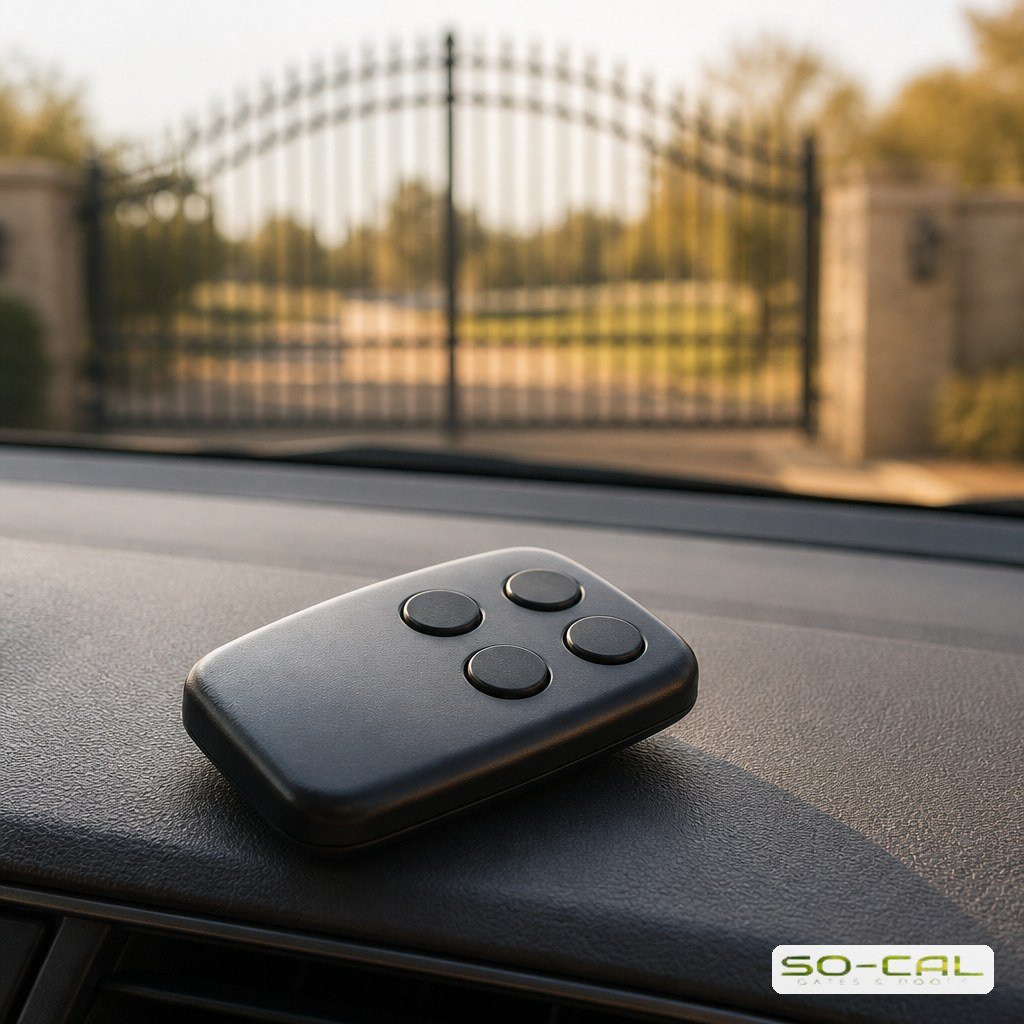
That second transmitter fails for a reason that has nothing to do with the transmitter. A code-hopping receiver accepts a press only from a unit it has personally been taught, because it checks each press against a counter and a key it stored when it learned that unit. The garage head unit did its learning the day the door went in. The gate receiver arrived eighteen months later with an empty memory and its own learn button, and was never shown the clip already on the visor. Another transmitter from the same family just produces a second unlearned unit. The frequency printed on the case describes the radio and says nothing about which receiver has been taught which transmitter.
Three ways to end up with one credential
- Put an external receiver at the gate that accepts the transmitter already on the visor, and land its relay output on the gate operator’s open input. Unlike the second route, it is still available once both operators are on the property.
- Match the radio while the gate is still on paper: a gate operator that accepts the transmitter family already learned into the garage head unit. One transmitter learned twice, and no relay — but only if the decision happens before the gate is ordered.
- Leave radio out of it: a keypad at the driveway, or an access control system relay, on the gate’s open input, plus the opener maker’s own wireless keypad at the garage, which takes a PIN of your choice. One code, programmed at both ends.
Two questions settle which route is open. Which receiver is the master — normally the garage head unit, because it learned first and lives indoors — and does the gate operator expose an open input you can reach. Without that input, only the second, family-matched route remains.
Range is a site problem, not a battery problem
Both radio routes put a receiver at the gate, where the same transmitter reaches less far than it does at the garage, and owners read the difference as a dying cell. The garage receiver’s antenna wire hangs in open air inside a wood-framed building. The gate receiver sits in a metal cabinet on a post, with an iron leaf beside it acting as a reflector and a vehicle body between it and the driver’s hand. Receiver instructions say to keep the antenna off metal surfaces and never bend or fold it, and point to a coaxial extension kit so it can be mounted outside that cabinet.
A site factor in the 380 to 399.9 MHz band
Some openers were built between 380 and 399.9 MHz, a range the Department of Defense has held as authorized user for decades. In December 2005 the Government Accountability Office reported, in GAO-06-172R, that the Department’s new land mobile radios worked in that same range as many unlicensed low-power garage door openers, and that because those openers operate as unlicensed devices they must accept any interference from authorized spectrum users. That condition still stands nationwide: 47 CFR 15.5(b) conditions operation on accepting interference caused by an authorized radio station. March Air Reserve Base shares a boundary with the city of Riverside, so the band is worth asking about before two barriers are committed to one family.
One Trench, Two Systems
The trench is the only piece of genuinely shared work, and it is shared in one direction. The garage door’s wiring finishes inside the building: a circuit at the ceiling, a wall control on the wall, sensors at the jambs. None of it leaves the structure. The gate is the half that has to cross the property — operator supply out to the entrance, a sensor or loop lead, a communication line if an entry station is going in at the curb.
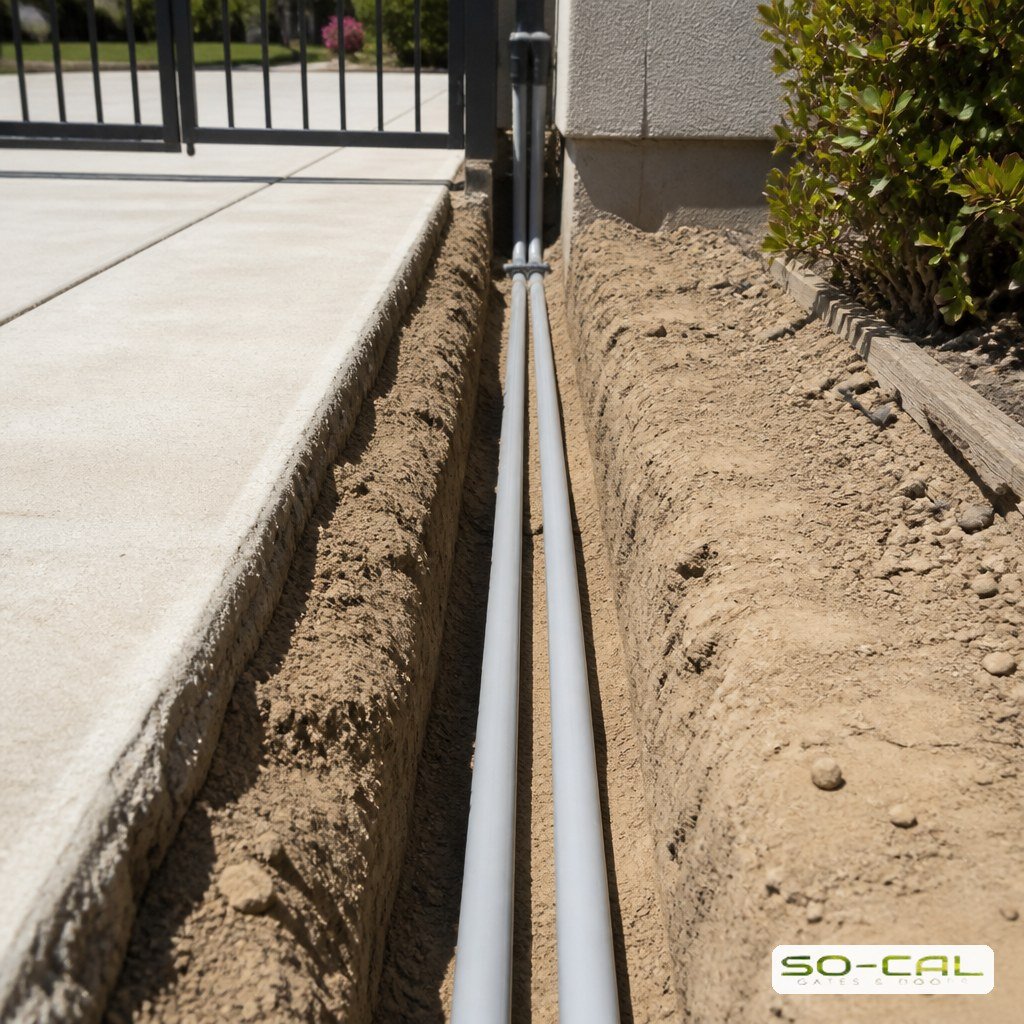
Pull a spare conduit beside the runs. The gate end is the end that grows — a second sensor, an entry station, a supply that gets upgraded — and the garage end almost never does, which is why the spare belongs on the gate side of the ditch. Garage door installation in Riverside stops at the building line; everything past it is the gate’s.
Conclusion: Decide the Credential Before the Second Operator
A garage door and a driveway gate share a band, the cover of UL 325 and a power failure. They do not share a rule book: a door operator built since 1993 falls under 16 CFR Part 1211 and, if installed since July 1, 2019, under California’s battery-backup statute, and the gate sits outside both. Settle how you intend to open the two of them — an external receiver landed on the gate’s open input, one transmitter family learned into both receivers, or one keypad code at both ends — before the second operator is ordered, while all three routes are still open. Call SO-CAL Gates & Doors at (951) 500-1806 to have both ends looked at together in Riverside, Corona and across the Inland Empire.
Frequently Asked Questions
Will my garage door remote open my driveway gate?
Only if the gate’s receiver has been taught that exact transmitter, or an external receiver that accepts it has been added at the gate and wired into the operator’s open input. Matching frequencies is not enough: a code-hopping receiver checks each press against a key it stored when it learned that unit. The added hardware goes at the gate end.
Does the six-inch photo eye rule apply to my gate as well?
No, and it is not a federal rule even on the garage side, though California law makes installers follow those instructions. The six inches comes from the operator manufacturer’s installation instructions, restated in DASMA Technical Data Sheet 364, and it governs the height of the photoelectric beam only — a contact edge travels with the door and has no floor height. A vehicular gate operator sits outside 16 CFR Part 1211.
Does California require a battery backup on a driveway gate operator?
Not under the garage door statute. Health and Safety Code section 19892 has required a battery backup function on residential automatic garage door openers sold or installed in the state since July 1, 2019, and subdivision (c) reaches a replacement door connected to an older opener. The statute does not mention gate operators, so on a single-family driveway gate backup stays a specification decision rather than a legal one.
Can one keypad code open both the garage and the gate?
Yes, as two keypads sharing one code rather than one keypad wired to both. At the gate, a keypad’s dry contact lands on the operator’s open input. At the garage, use the opener maker’s own wireless keypad, which takes a PIN of your choice. Check the opener’s manual before wiring a third-party relay to it: one current owner’s manual says older door controls and third-party products are not compatible.
Why does my remote work at the garage but not at the gate?
Check the antenna before the cell: receiver instructions say to keep it off metal and never bend or fold it, and point to a coaxial extension kit for mounting it outside the gate’s metal cabinet. An opener between 380 and 399.9 MHz also shares its range with military land mobile radios, and under 47 CFR 15.5(b) it must accept their interference wherever it is installed.