

Solar Gate Power Sizing: Panels, Batteries and Control Boxes
A solar gate opener is a battery system with a trickle charger, so solar gate power sizing starts at the battery. Budget daily energy to ride out three gray December days; an undersized system can fail on the third morning with a car waiting.
What a Solar Gate Opener Has to Carry All Day
Most sizing conversations start at the motor, the visible load. On a residential driveway the idle draw can match it: an operator moves for minutes a day and spends the rest with its board energized, its receiver listening and its entrapment sensors drawing current.
So count the two halves separately: watt-hours per cycle times cycles per day, plus standby amps times volts times twenty-four hours — both in watt-hours per day, before anyone names a panel wattage.
Cycle Energy Versus Standby Draw
Cycle watt-hours equal amps times volts times travel seconds divided by 3,600. For a low-voltage operator the figure is small. A 12-volt motor pulling 10 amps for 20 seconds consumes about 0.7 watt-hours, and a full open-and-close is double that: twenty cycles a day still lands under 30 watt-hours. Now set a board idling at 40 milliamps beside it — half a watt, running continuously, close to 12 watt-hours a day. Add two photo eyes at 20 milliamps each and standby is nearly half the budget.
Travel time comes from the gate itself. UL 325 holds a Class I or Class II horizontal slide operator to one foot per second when it is pulling seventy-five pounds or more, so a twenty-four-foot opening held to that ceiling takes at least twenty-four seconds, and on a wide sliding gate installation that sets a floor under watt-hours per cycle.
Why You Cannot Put Monitored Sensors on a Timer
On an operator manufactured after 11 January 2016, external entrapment protection devices are monitored: the operator checks each is present and properly connected at least once in every open and close cycle, and if one fails, the operator must then run only on constant pressure in the direction that device protects, or move only by hand. So an overnight timer on the sensors ends automatic operation in the directions they guard. Only the operator’s own low-power mode may cut them: one manufacturer’s solar mode drops the 12-volt output on its normally-closed sensor block 30 seconds after the gate stops with no loop active. Unless your manual says it does, count them all day.
What Changes on an Operator Built Before the 2016 Cutoff
There is no retroactivity in UL 325, which matters when solar is retrofitted onto an older gate. An operator manufactured on or before that date need not be upgraded and was not required to monitor.
Reading the Idle Draw on an Older Board
Its standby figure may be lower, with fewer external devices, or higher, if its board was designed around a transformer rather than a battery. Read the idle draw at the gate you have, receiver and sensors connected.
The One Number Everything Below Divides Into
Everything after this is a division problem, and the numerator is one figure: watt-hours per day at the operator’s own voltage. Insist on that unit. Amp-hours will not carry the argument, because a 24-volt and a 12-volt operator drawing identical amp-hours are not carrying identical loads.
Solar Gate Power Sizing Against Your Worst Month
The worst case in Riverside is not August heat; it is the third week of December. At this latitude the sun is up for a little under ten hours around the winter solstice against roughly fourteen and a half in late June, and the low sun angle means the panel harvests a smaller share of even those shorter hours. Size to an annual average and the system runs beautifully from March to September, then fails in the month you were counting on.
Days of Autonomy and Depth of Discharge
Two decisions size the battery. The first is days of autonomy: how many consecutive low-harvest days the gate must survive with little charging. One day of reserve is not a reserve. The second is depth of discharge. Sealed lead-acid batteries give up cycle life quickly when routinely run down hard, so plan around half the nameplate amp-hours and treat the rest as untouchable.
Battery life falls as operating temperature rises, and a sealed enclosure facing south on a Riverside driveway in August runs hotter inside than the air around it. Where the box goes is a sizing decision: shade it, vent it, or replace the battery sooner than its datasheet implies.
A Worked Example at Riverside’s Latitude
Twenty cycles a day at about 1.3 watt-hours each is roughly 27 watt-hours; a board at 40 milliamps plus two sensors at 20 each is 80 milliamps, which at 12 volts is 0.96 watts and about 23 watt-hours across the day. Call the load 50 watt-hours a day. Now December. National Solar Radiation Database figures, run through the European Commission’s PVGIS calculator to a fixed south-facing plane tilted roughly to Riverside’s latitude, give about 4.9 kilowatt-hours per square meter per day in December against about 6.4 averaged over the year — five peak sun hours in the design month. Carried through the model’s losses, that is close to 3.8 watt-hours a day per nameplate watt. Round it down to 3 for dust, for the oleander that will half-shade the panel by its third summer, and for what a lead-acid battery loses between charge and discharge.
Fifty watt-hours divided by three is about seventeen watts of panel, and that only breaks even on an average December day. Break-even is not a design: a panel that exactly replaces the day’s consumption never refills a battery a gray spell emptied. Double it. Thirty to forty watts returns roughly 90 to 120 watt-hours on that December day: the load, plus 40 to 70 to put back into the battery. On the same derating a ten-watt panel is not a smaller answer but a wrong one: about 30 watt-hours in December and the low 40s in its best summer month, short of 50 all year.
The battery falls out of the same figure. Fifty watt-hours times three days of autonomy is 150 watt-hours that have to be available; at half the nameplate that is 300 watt-hours installed, and at 12 volts, 25 amp-hours. Set that against a 12-volt 18-amp-hour battery, larger than the 7-amp-hour batteries some operators ship with: 216 watt-hours, near 108 usable, about two days at this load and not three. The panel decides how quickly you recover; the battery decides whether the gate opens on the third gray morning.
Inside the Control Box: Charge Controller, Wire Run and Wind
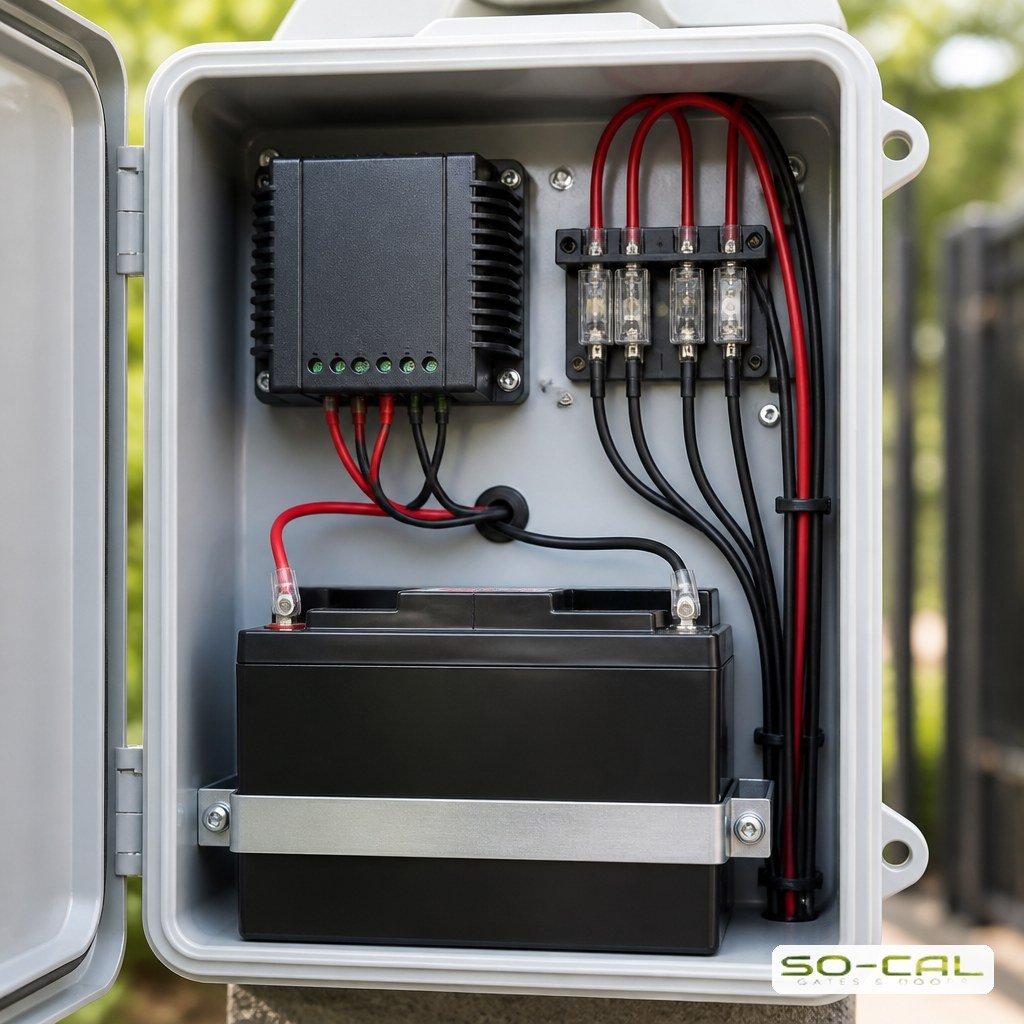
The box holds the operator board, the battery, the charge controller and usually the radio receiver. The controller has to match the battery chemistry and the system voltage, and it should carry a low-voltage disconnect so one deep discharge does not end the battery. The panel lead and the battery lead each deserve a fuse.
Distance is the quiet failure, through voltage drop on the panel lead: if the controller never sees its absorption voltage, the battery never reaches full charge, and a lead-acid battery held part-charged through a winter loses capacity that later sunshine does not return. A panel put on the far post because that is where the sun is can measure perfectly well on a clear afternoon and still starve the battery across December.
Then there is wind. A Santa Ana event loads a panel like a sail, and that surface was not in the post’s original numbers. Keep the panel clear of the swing radius and off anything that moves, and plan on washing it: haze and construction dust leave a film that costs output long before anyone notices. That belongs on the same maintenance list as the rest of a gate opener installation in Riverside.
When Solar Is the Wrong Answer for a Gate
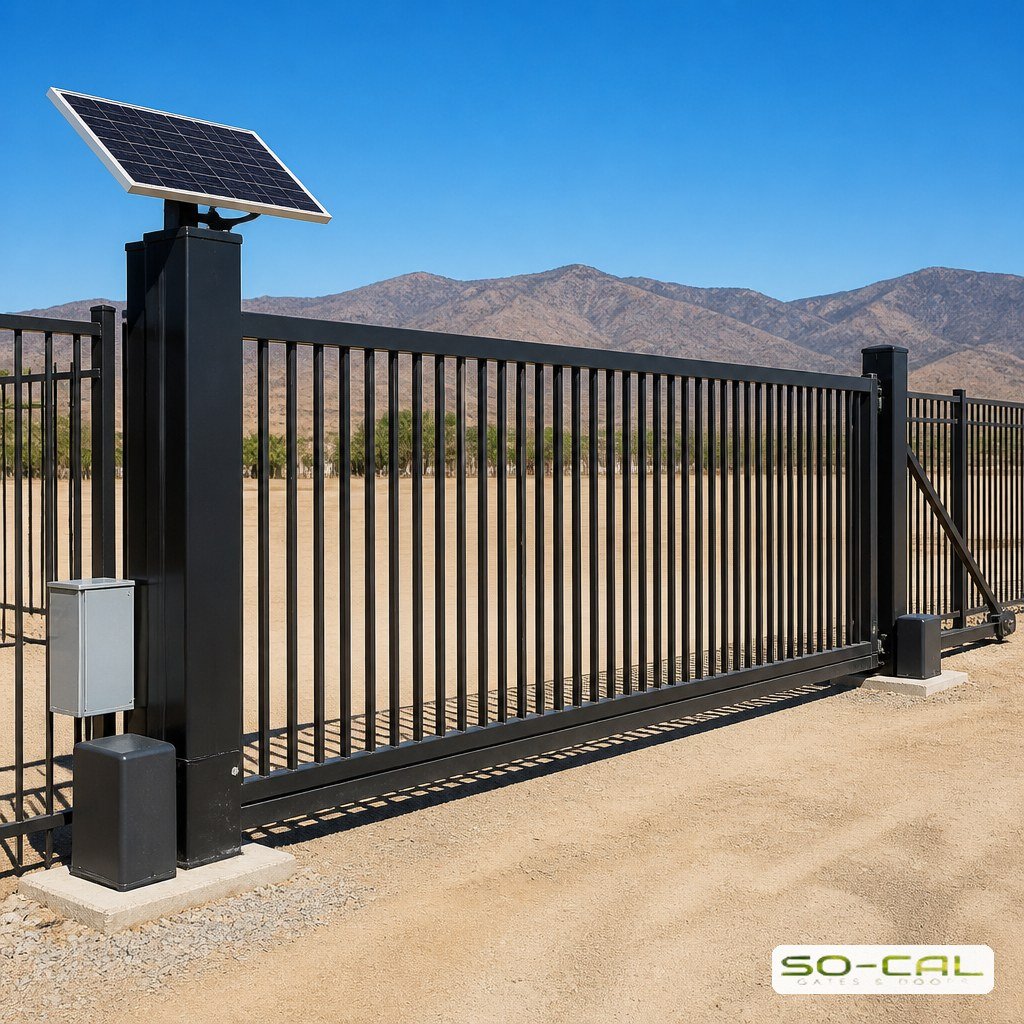
Solar answers one problem well — there is no practical path for line power to the gate — and several others badly. The clearest disqualifier is traffic, and it is a watt-hour argument. Run the worked example at two hundred cycles a day instead of twenty: the cycle column goes from 27 watt-hours to about 270, standby does not move at all, and the daily load rises from 50 to nearly 300 — six times the panel and six times the battery for the same leaf and the same motor.
The second disqualifier is standing current from everything that is not the operator. A magnetic lock holds by drawing power continuously: one manufacturer’s published figures for its 12-volt locks from 600 to 1,800 pounds run from 250 to 350 milliamps, so even at the low end, three watts held all day is about 72 watt-hours — more than the entire gate budget above, for a device whose only job is to stay still. Loop detectors come in low-power versions made for this case: one sold for solar and battery operators is rated under 8 milliamps with no vehicle on the loop, under two and a half watt-hours a day at 12 volts. Every camera, intercom board and reader wants the same battery. Once the design includes that kind of access control hardware, what you are sizing has stopped being a gate load.
- A magnetic lock or a powered credential reader shares the enclosure.
- Your daily cycles approach what the operator’s published solar chart allows at your real accessory draw with several rainy days of reserve.
- The only clear winter sky is on the far side of a mature tree nobody intends to remove.
- The architecture leaves no south-facing mounting point other than the gate itself.
- Line power already reaches a garage, a pedestal or an existing exterior branch circuit within a short trench of the gate.
An association’s rule is not on that list; ask first. California’s Solar Rights Act, Civil Code section 714, voids covenants that effectively prohibit or restrict a solar energy system, though an association may still impose reasonable restrictions, and an application not denied in writing within forty-five days is deemed approved unless the delay is the result of a reasonable request for additional information.
Conclusion: Size the Load First, Then the Panel
A solar gate opener is a load problem wearing a panel. Count the watt-hours the operator and its sensors consume in a day, size the battery for a run of gray mornings at a shallow depth of discharge, then choose the panel against December rather than June. Solar is the one gate decision a meter settles faster than an opinion: contact SO-CAL Gates & Doors at (951) 500-1806 and have the idle draw and the real cycle count read at your own operator.
Frequently Asked Questions
How big a solar panel does a gate opener need?
The panel follows the load, so settle the load first: watt-hours per cycle times cycles per day, plus standby current in amps times voltage times twenty-four hours. Divide by what a nameplate watt returns on a December day here — near three watt-hours after the model’s losses and a field derating — then double it so the panel also refills the battery. A 50-watt-hour gate lands around thirty to forty watts.
Will a solar gate keep working through several days of rain?
Only if the battery was sized for it. A solar system runs from the battery continuously and uses the panel to refill it, so autonomy is a battery decision, not a panel one. Three days at 50 watt-hours is 150 watt-hours that must be available, which at a working half-depth of discharge means about 300 watt-hours installed — 25 amp-hours at 12 volts, more than an 18-amp-hour battery holds.
Can solar be added to an existing gate opener?
Sometimes, and the operator’s age is part of the answer. It turns on the board’s voltage and idle draw, and on whether it can charge from a panel through a controller rather than a transformer. An operator manufactured on or before 11 January 2016 is not required to monitor its external entrapment devices, so its standby figure, and therefore its panel and battery, will not match a current model’s.
Do monitored safety sensors have to stay powered on solar?
You cannot switch them off yourself. On an operator manufactured after 11 January 2016 they are monitored, and an interrupted supply is a fault that ends automatic operation in the protected direction. Only the operator’s own low-power mode may cut them, and the operator still checks each one at least once in every open and close cycle. Read how your manual treats them before counting them for twenty-four hours.
Where should the solar panel be mounted?
Facing south and steeper than the latitude, around 50 degrees here: PVGIS gives about nine percent more December output there than at latitude tilt, while December stays the weakest month; a few degrees steeper and July drops below it. Then clear winter sky, off anything that moves, and a short run to the control box.