

Sliding Driveway Gate Sizing and Clearance: A Riverside Guide
A sliding driveway gate does not need room to swing, and that is usually why people choose one. What it needs instead is room to retract, a larger and less obvious requirement than the swing arc it replaces. A slide gate gets mis-sized when somebody pulls a tape across the opening and never along the fence beside it. Whether one belongs on a Riverside driveway comes down to the clear opening, the leaf, the run it retracts into, and the clearance around that leaf in three places: under it, beside it and behind it.
What a Sliding Driveway Gate Needs Beside the Opening
Two dimensions describe every slide gate, and they are not the same number. The clear opening is what a vehicle drives through, measured between the finished faces of the posts at their closest point. The leaf is the panel that covers it, and on a cantilever it is always longer, because part of it stays behind the opening as counterweight. How long that tail runs comes off the manufacturer’s chart, and reading it is part of sliding gate installation in Riverside. Sizing needs one number from it: the finished frame length, which the fence line has to hold.
An 18-foot clear opening is not an 18-foot gate. One maker’s current cantilever specification puts it at a 26-foot panel, with both truck posts inside that length, and all of it has to go somewhere when the gate opens.
Clear width is not the width you ordered
Measure between the faces that protrude, not between post centerlines. Column wraps and pilaster caps take a bite out of the number a vehicle sees: a pair of four-inch stone wraps turns a 16-foot post-to-post span into a 15-foot 4-inch opening. Where the driveway is also a fire apparatus access road, the 20-foot road width in California Fire Code 503.2.1 does not govern the gate: that sentence excepts approved security gates and sends them to Section 503.6 and the fire code official. Ask your fire department for its gate width before the columns are poured.
The run behind the opening, in numbers
The leaf has to retract into unobstructed fence line: no shrubs, no condenser pad, no utility pedestal, no retaining wall that steps up halfway along. Run a tape along the fence line from the post on the side the gate opens toward, the front truck post on a cantilever, and write down where the first real obstruction sits. That one measurement usually chooses the gate type for you.
- Cantilever over an 18-foot opening: the whole frame, 26 feet of clear fence line on that specification, plus the stop margin.
- V-track rolling gate, same opening: no tail, only overlap. One maker’s guide sizes an automated leaf at the opening plus about 14 inches, so plan a little over 19 feet of run plus the end post.
- Bi-parting pair: the run splits across two sides, though the tail behind a short leaf does not shrink in proportion.
- Telescoping slide: nested panels cut the run further, in exchange for a second carriage to keep in alignment.
Where that run does not exist, a slide gate is the wrong machine for the opening. It is also the reason to settle the fence line and the gate together: a run planned alongside fence installation in Riverside stays clear of the condenser pad and the pedestal, while a run discovered afterwards means moving something already set in concrete.
Ground Track or Cantilever: the Driveway Decides
A V-track run is a drainage commitment
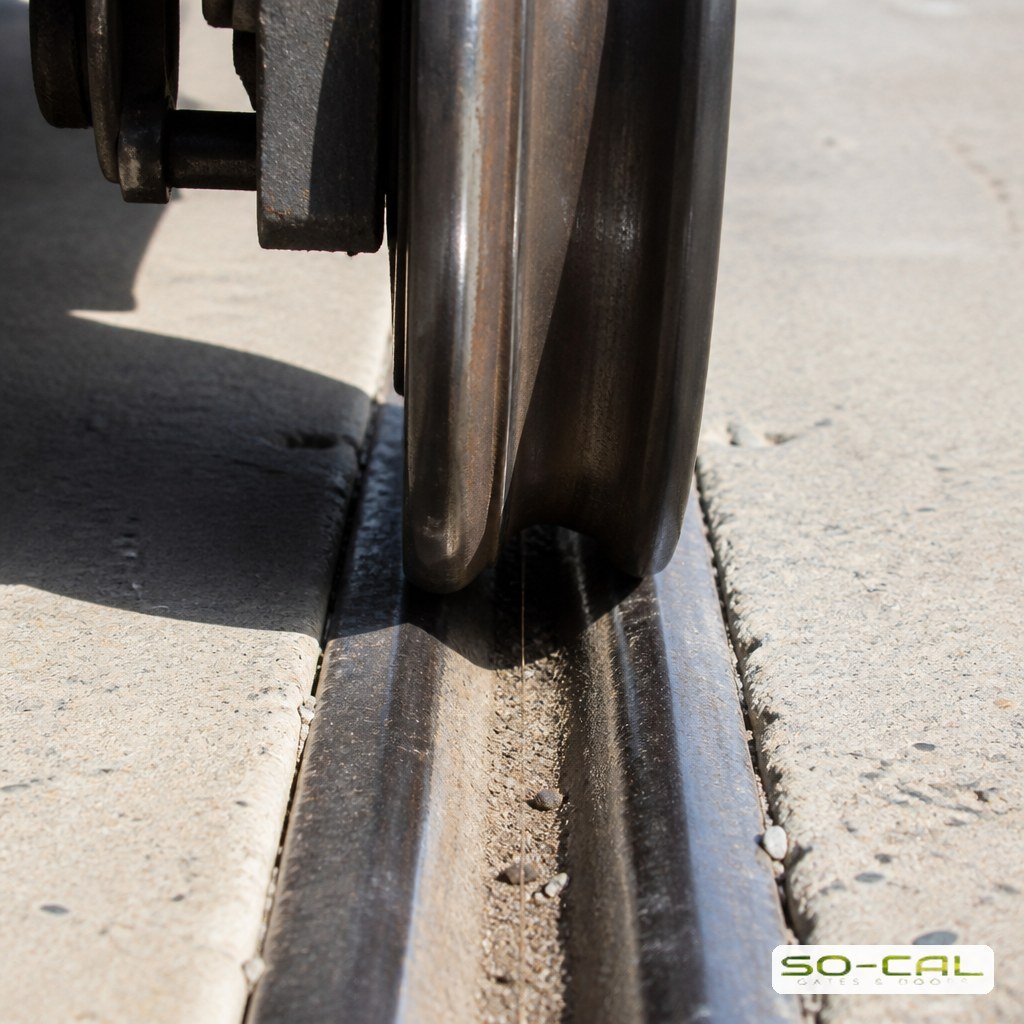
A V-groove wheel on a ground track needs the shorter run, since nothing stays behind the opening as counterweight. In return it asks for a rail line flat and clear along its full length, which makers’ instructions set at twice the width of the opening, on a driveway graded to drain. What grit does to that groove belongs to the installation scope. For sizing, walk the travel with a straightedge: if the rail line crosses a gutter, a valley or a saw-cut joint, the shorter run is not available.
A cantilever needs the longest run of any slide type
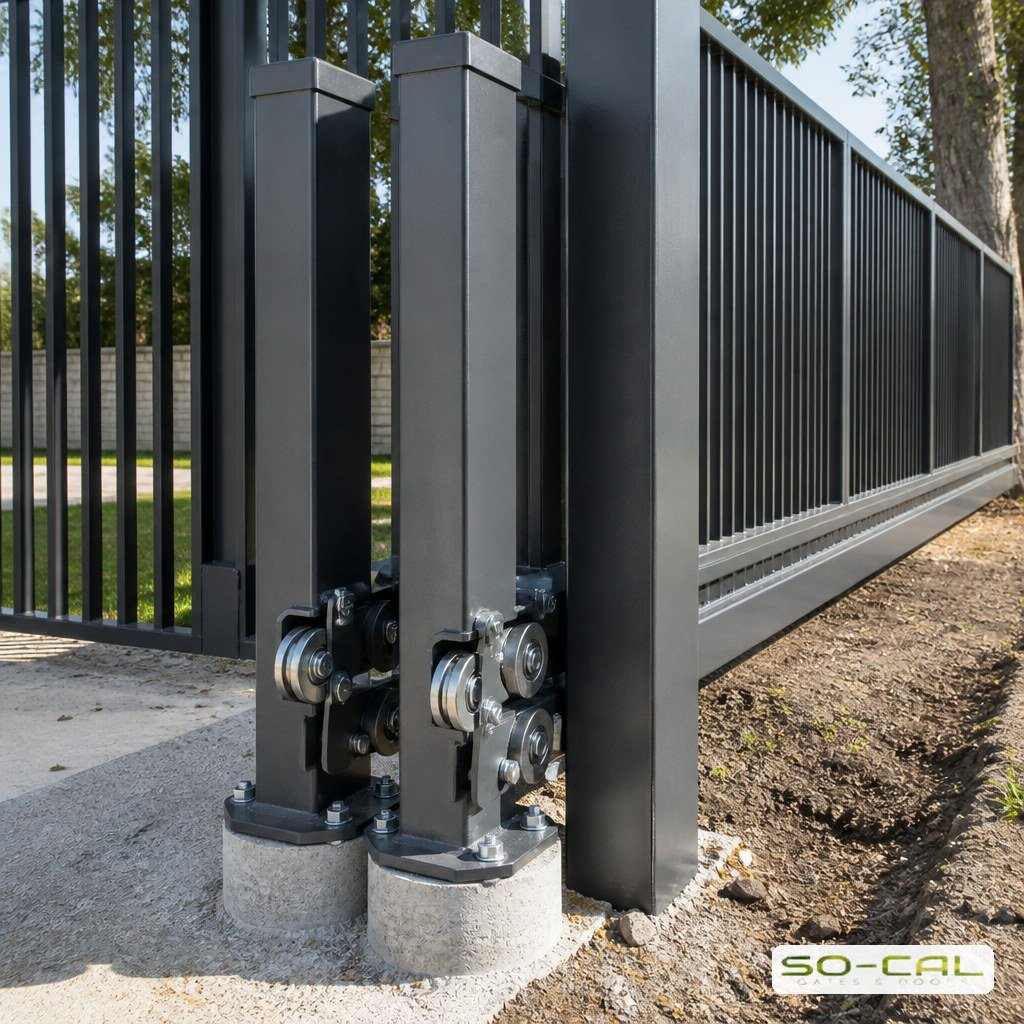
A cantilever leaf rides above the driveway instead of on it, which is why it survives a crowned or climbing drive that would defeat a ground track. It asks for the longest run of the four options, because the counterbalance tail is fence line you cannot use for anything else, open or closed.
Clearance in Three Places, and How Each Is Measured
Clearance is checked in three places: under the leaf at grade, beside it at the posts, and behind it along the run. A closed-gate survey gets this wrong, because the gap under the leaf changes as it travels and the run behind it exists only when the gate is open.
Under the leaf: measure at the crown, not at the gutter
The bottom rail of a slide gate is a straight line and the driveway beneath it usually is not. On a crowned or climbing drive, set the rail to clear the high point and the gap at the low point is whatever the grade change happens to be. So write down two numbers: the highest point the leaf passes over, which sets the rail, and the lowest, which tells you how large the gap becomes. Neither is fixed by a published clearance figure. Take both before the leaf is built; afterwards you get only what adjustment the truck hardware offers.
Beside the leaf: the gap at the support posts
On a Class I to III horizontal slide gate, ASTM F2200 holds the gap between the gate frame and the fixed object nearest the roadway, such as a support post, to 2-1/4 inches, measured level and parallel to the driveway, with the gate fully closed and again fully open. So take it at the support posts, square off the face of the frame, not along the gate line. The receiver guide is a separate clause: on a single leaf it must be recessed behind the leading edge of the receiver post or fixed object unless mounted more than 8 feet above grade, so below that it takes nothing from your clear width.
Behind the leaf: overtravel and the standoff along the run
Two numbers live back there, both taken with the gate fully open. The first is overtravel: the leaf stops where the stop is set, so the run has to hold the leaf plus that margin. The second is standoff: the leaf hangs outboard of the posts on the truck brackets, so its face travels in a plane several inches off the fence line. Anything inside that plane is a strike even though the ground beneath it is clear.
Sighting the standoff instead of stepping it
Standoff is not a ground measurement, so a tape dragged along the dirt will never find it. Pull a string line from the face of the front truck post, parallel to the fence, at the heights the bottom rail and the top rail will occupy. Anything it touches is a strike. Carry it back the full length of the parked frame plus the stop margin, not just the width of the opening, because the tail parks furthest from the post.
What lives in that plane on a Riverside side yard
Look along the fence for anything standing at leaf height: the condenser pad set tight against the fence when the air conditioning was replaced, the backflow assembly on its riser, a utility pedestal on the easement, a block wall pilaster that projects past the wall it interrupts. Each stands within the height a gate leaf occupies, so the string line finds it where a tape on the ground would not.
The obstruction that is not there today
The last obstruction is the one a tape cannot see, because it is seasonal or it moves: the trailer parked along the fence all summer, oleander that widens every season, the bins on collection day. A swing leaf never travels along the fence; a slide leaf parks there every time it opens. Measure the run at its narrowest, not its emptiest.
Sizing the Operator to the Leaf
The leaf you just sized is what the operator has to be rated for, and the rating has two ceilings that apply at once: weight and length. Nice’s instructions for its RD400 rack operator give 400 kg or 8 m, and allow 20 cycles an hour on a leaf up to 5 m but 14 on one of 7 to 8 m. A 26-foot cantilever frame is 7.9 m, so it lands in the tightest length band however little it weighs. Which usage class the operator must be listed to is a separate question, settled under gate opener installation in Riverside.
Sizing also decides where the safety devices end up. Entrapment protection follows the risk, one direction of travel at a time, so the opening stroke of a slide gate can need covering as well: where the trailing edge of the retracting leaf closes toward a wall, post or fence at the end of the run, the device covering that stroke is mounted behind the gate, further from the operator and the conduit the longer the run gets.
Where Slide Gate Sizing Goes Wrong on Inland Empire Driveways
Four failures each start as a measurement nobody took. The short-run build: the leaf fits the opening, the tail does not fit the fence line, so the leaf is shortened at the shop, the counterbalance goes with it, and the leading edge sags. The stepped-run build: 26 feet on the tape along the ground, but a retaining wall steps up at 18 feet, so the last third of the run exists for the tape and not for the leaf. The mid-travel strike: a condenser pad inside the leaf’s plane, invisible to a tape run along the ground. The wind case: a privacy backer added to a 26-foot leaf after the posts were specified.
Each is easier to solve with a tape measure than with a rebuild, so a slide gate scope should open with the run, the grade along it and the clearances around the leaf, before anyone discusses panel style.
Conclusion: Measure the Run Before You Choose the Gate
A sliding driveway gate is sized by the property rather than by the opening. The clear opening tells you what a vehicle passes through; the leaf, how much fence line the gate occupies when open; the run, whether a slide gate belongs there at all; and the clearance under, beside and behind the leaf, whether it can be built and automated on that driveway. Take the measurements on the ground, in the order the gate will move. To have them recorded for your driveway in Riverside or Corona, call SO-CAL Gates & Doors at (951) 500-1806 and we will walk the opening and the run with you.
Frequently Asked Questions
How much fence line does a sliding gate need beside the driveway?
A cantilever retracts its whole frame, the clear opening plus the counterbalance tail. One maker’s current specification puts an 18-foot opening at a 26-foot panel, so plan on 26 feet of clear fence line until the chart for your hardware says otherwise. A V-track rolling gate needs a little more than the opening itself. Measure from the post on the side the gate opens toward to the first real obstruction, not to the property line.
Can a sliding gate work on a sloped driveway?
A cantilever usually can, because the leaf rides above grade rather than on it. Its bottom rail is still a straight line over a driveway that is not, so set the rail from the highest point the leaf passes over, then measure the gap at the lowest so the gate is built for it. A ground track is far less forgiving: its rail has to survive every gutter, valley and saw-cut joint it crosses.
How wide does a driveway gate have to be?
Wide enough for the vehicles that use it, measured between the faces that protrude. Where the driveway is a fire apparatus access road, California Fire Code 503.2.1 excepts approved security gates from its 20-foot road width and sends them to Section 503.6 and the fire code official. Riverside County Fire’s access policy for one- and two-family dwellings sets the minimum unobstructed gate width at 14 feet; the cities of Riverside and Corona run their own fire departments, so confirm with the one serving your address.
What is the difference between a gate’s clear opening, its leaf and its run?
The clear opening is what a vehicle passes through, measured between the faces that protrude. The leaf is the panel that covers it, and on a cantilever it is longer than the opening, because the counterbalance tail stays behind it. The run is the clear fence line the leaf retracts into. Ordering from the first number without measuring the third leaves the leaf nowhere to go.