
SO-CAL Gates & Doors handles gate repair on automatic gates across Riverside and the wider Inland Empire. Four answers decide what the visit looks like: the direction the leaf fails in, whether the motor runs while the leaf stands still, whether the keypad or intercom fails while a remote still works, and how, if at all, the operator beeps. Faults below are grouped by what you see or hear, not by which part gets replaced.
Nine Gate Faults and What Each One Points To
Start with the direction it fails in. An eye or edge wired to guard one direction is ignored in the other, so a one-direction fault narrows the list.
- Dead and silent: a blown fuse, or a tripped GFCI with the backup battery since run flat.
- Motor runs, leaf still: stripped drive gear, sheared chain link, backed-off sprocket screw, failed gearbox.
- Opens but will not close: a blocked or misaligned photo eye guarding the closing path, or a stuck exit loop holding it open.
- Reverses while closing: a close-side photo eye or edge tripping, an active loop, or unexpected force from a dragging roller, a seized hinge or debris in the path.
- Beeping: an alarm as the leaf stops means a second sequential obstruction has latched the operator out until reset; on some operators, three beeps at each command mean a low battery.
- Keypad or intercom dead, remote fine: the entry device or its wiring, so access control system service in Riverside.
- Swing leaf dragging at the latch: hinge sag, from an elongated barrel or a leaning post.
- Chain slapping on the return side: check chain tension, alignment and sprocket wear against the operator manual.
- Sensors tripping with nothing there: check for a misaligned beam, an obstructed receiver or a wiring fault.
This page is the symptom index; the longer gate repair guide picks the same faults up after one has been scoped.
Why the Same Symptom Has Two Different Repairs
One symptom can call for two different repairs. Three properties decide which.
The first is what the leaf weighs against how often it moves. Open picket and solid infill at the same 14-foot length are not the same load, and the heavier one changes the load the same drive must move. Operator duty is the subject of gate opener installation in Riverside, not of a repair visit.
The second is monitoring. Under ANSI/CAN/UL 325, an operator manufactured after 11 January 2016 must monitor each external entrapment protection device, checking it is present at least once per open and close cycle. If one is missing, or its wiring opens or shorts, the operator must then run only on constant pressure in the direction that device protects, or move only by hand. A photo eye replaced with a part the board does not recognize therefore drops the gate into one of those two fallbacks; the operator is not the failed part.
The third is geometry, which no setting corrects. Measure the leaf square on stands, then square again hung; the difference says whether the leaf is wrong or the post is leaning. A gate built outside what ASTM F2200 specifies for its type needs fabrication, the scope of sliding gate installation and swing gate installation.
How a Gate Repair Call Runs On Site
A leaf heavy end to end on manual release is a load problem at the rollers or hinge post; raising force to push through it interferes with the safety reversal.
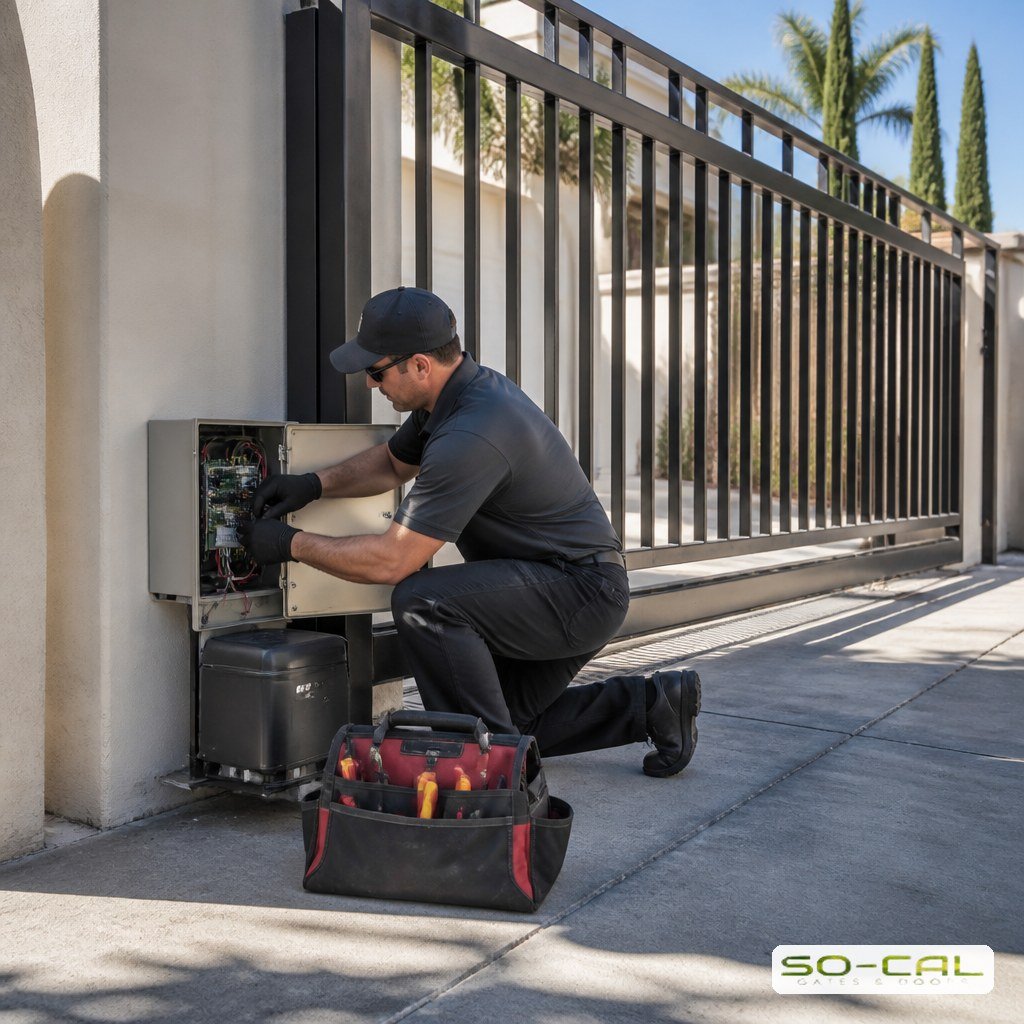
- Power off, operator on manual release, leaf moved end to end by hand. A leaf that binds at one point has a mechanical fault no setting reaches.
- The assembly is measured: leaf length and weight, roller and rail condition, hinge plumb, post movement at grade, and the whole travel path.
- Electrical checks follow: incoming voltage, control board, limit inputs, continuity along the sensor runs, and battery capacity under load rather than at rest.
- The gate is cycled with a current clamp on the motor leads. Draw at startup and through travel shows whether the operator is moving the leaf or fighting it.
- Limits and force are set last, and every entrapment protection means is proven in the direction it guards before the site is left.
What Riverside Conditions Do to Gate Hardware
- Santa Ana events load a solid-infill leaf like a sail, and that load lands on whatever carries the leaf: hinges on a swing gate, rollers and guide on a slide gate. Hinge and roller wear from that load later shows up as the dragging and force reversals in the fault list above.
- Heat affects battery reserve as well as operator performance. One operator manual rates its operator to 158°F; Yuasa rates its NP sealed lead-acid batteries only to 122°F, bases their roughly five-year float life on 68°F, and states that heat kills batteries. Through a Riverside summer in an unshaded enclosure, the backup battery can age faster, and a worn one can leave the gate stuck at one end of travel in an outage.

Conclusion
The four things that decide what goes on the truck can all be checked from the driveway: which direction the leaf fails in, whether the motor runs while the leaf stands still, whether the keypad or intercom fails while a remote still works, and how, if at all, the operator beeps. Call SO-CAL Gates & Doors in Riverside at (951) 500-1806 with those four.
Frequently Asked Questions
Why does my gate reverse partway while closing?
Something told the operator to reverse. A photo eye or edge guarding the close may be tripping, a reverse loop may be reading the leaf or a vehicle, or the operator’s own inherent sensor may be feeling extra force from a dragging roller, a seized hinge or debris in the path. Treat that force as a mechanical fault; raising the force setting only blunts the safety reversal.
My gate motor runs but the gate does not move. What is that?
The motor is turning, but its motion is not reaching the leaf. On a slide gate, check the drive gear, chain link and sprocket set screw. On a swing gate, check the gearbox and arm pins. Running alone does not prove the motor is healthy; the drive connection needs inspection before choosing the repair.
My gate stopped dead and something is beeping. What happened?
Two different faults beep. On a second sequential obstruction an inherent sensor must stop the gate, sound an entrapment alarm, and not run again until a hardwired reset input is received, with someone in line of sight of the gate: clear what the leaf hit, then reset. Some operators also beep three times at each command on a low backup battery, which needs charging or replacing, not a reset.
Does gate repair in Riverside need a permit?
Jurisdiction decides that as much as the work does. Inside city limits, the City of Riverside Building and Safety Division requires a permit to install, alter, repair or replace any code-regulated electrical system, so a new circuit out to the operator is permit work. A Riverside address in unincorporated county territory goes to Riverside County Building and Safety instead.