

Electric Driveway Gates: A Buyer’s Guide to Geometry, Operators and Controls
Electric driveway gates are decided in a fixed order, and the rework comes from taking it backwards: geometry picks swing, slide or fold, the gate picks the operator, the operator picks the safety devices it can monitor, and only then is the control method a real choice. Here is that sequence for driveways in Riverside, Corona and the Inland Empire.
Electric Driveway Gates Begin at the Opening, Not the Operator
Step one ends in a geometry, not a product, and its measurements are taken where a leaf would actually travel: grade change across the arc a swing leaf would sweep, or along the fence line a slider would park against, rather than down the length of the drive. A drive wide enough for two cars but with a retaining wall three feet off the post has already ruled out one geometry, and no amount of horsepower puts it back.
The three geometries fail in different directions. A swing leaf needs clear arc on the property side. A slide gate needs clear fence line to park in, and that stretch of fence comes into the job with it. A bi-fold needs less of both and adds a second hinge line to keep aligned. Settling this before the posts are set is the point of planning an automatic driveway gate installation in Riverside rather than adapting to what got poured.
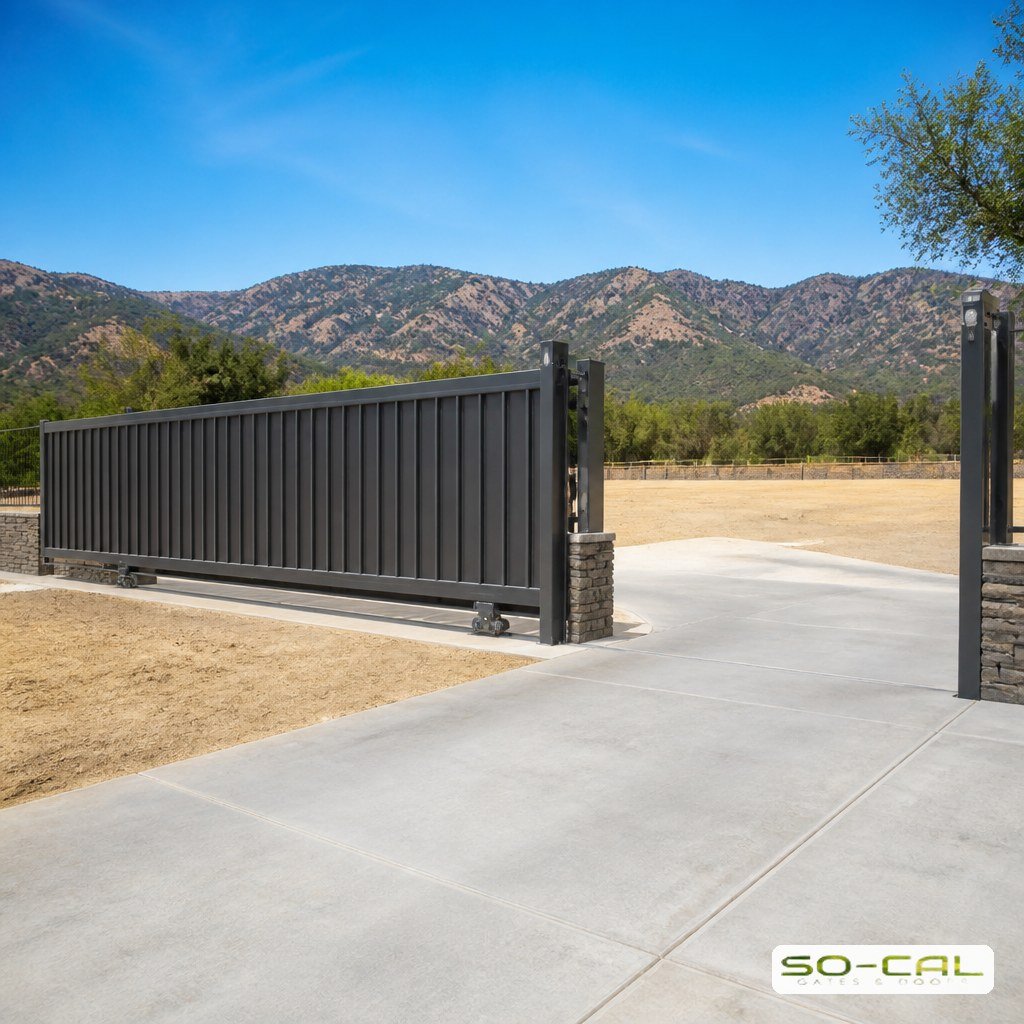
Swing Gates: the Arc Is the Constraint
A twelve-foot leaf opening ninety degrees sweeps a quarter circle of twelve-foot radius: twelve feet of ground, measured out from the hinge, that has to stay clear of parked cars, planters and the driveway’s own rise. ASTM F2200 then limits how close to a fixed object — a wall, a pillar, a column — the open leaf may come to rest, and its clearance provisions carry exceptions: a zone that cannot meet the geometry may be given UL 325 entrapment protection instead. A pilaster beside the open leaf is therefore a design decision with two answers, not a detail for installation day.
When the Driveway Rises Toward the House
A leaf swinging inward over a driveway that climbs from the street loses clearance partway through its arc, so it either drags or hangs high enough that the gap beneath it becomes the new problem. Swinging it outward over the sidewalk is off the table: UL 325’s installation instructions do not let a swinging gate open into a public access area. Two answers that stay on your own ground are to split the opening into shorter leaves, which reach less far up the slope, or to stop fighting the grade with a sliding gate instead of a swing.
Bi-Parting Leaves and the Shorter Arc
Splitting a sixteen-foot opening into two eight-foot leaves halves the arc radius, and that can be the whole difference between a gate the driveway can hold and one it cannot. It also eases the bending load on each hinge post. The trade is a second operator, a second hinge set, and a closing sequence the controller has to get right every cycle.
The Astragal Where the Leaves Meet
An astragal closes the vertical gap where the two leaves meet. It is part of the leaves, so it is settled with the gate, before an operator is sized to move it.
What the Gate Hands the Operator
UL 325 sorts vehicular gate operators into four usage classes by who reaches the gate rather than by how large it is, and choosing among them is the gate opener installation for a Riverside driveway half of the decision. What the gate hands that decision is three numbers: leaf weight, leaf length and honest daily cycles. An operator publishes weight and length as one paired limit and duty as another, and clearing one is not clearing the others.
UL 325 caps the speed of a slide gate and sets no speed limit for a swing gate: Class I and Class II slide operators pulling seventy-five pounds or more may not exceed one foot per second. Where your driveway meets a road with no shoulder, that makes a wide slide gate a control decision, not a motor one: it has to be moving before you arrive.
Entrapment Protection Is Two Means, and the Operator Supplies One
UL 325 sets a minimum quantity of entrapment protection means for each direction of travel: two opening and two closing for a horizontal slide gate, and two in each direction for a swing gate unless one direction has no entrapment zone at all. Those means are not all devices you buy. The operator’s own inherent sensing is Type A, and it counts as the first of the two. The ordinary Class I driveway build is therefore that inherent sensing plus one external device of a different type per direction — not four sensors on the posts.
The letters are how you read a quote. Type A is inherent. Type B1 is a non-contact sensor, a photo eye; Type B2 is a contact sensor, an edge. Type D is a control that moves the gate only while you hold it, and Type C, inherent force limiting, sits on the permitted list for swing operators and barrier arms rather than for slide. The same type cannot serve as both means, so inherent sensing plus a photo eye satisfies the rule and two photo eyes never do, however they are aimed.
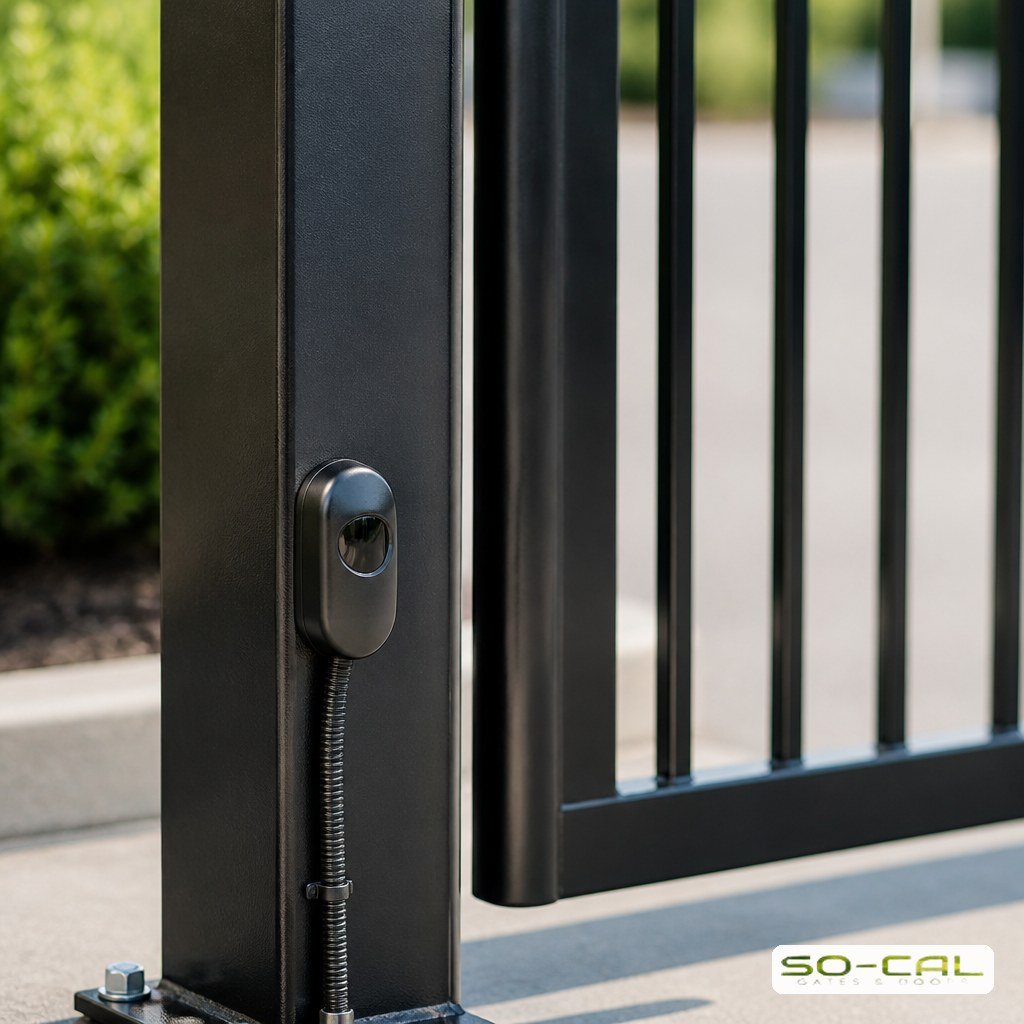
What Monitoring Actually Means
An operator manufactured after 11 January 2016 must monitor every external entrapment protection device, confirming each one is present and correctly connected at least once during every open and close cycle. When one stops answering — a broken wire, a lost wireless link — the operator must then run only on constant pressure in the direction that device protects, or move only by hand. An older operator is not required to upgrade, which matters when deciding whether to keep one. After an obstruction is sensed, reversal must begin within two seconds and the gate must travel back at least two inches. A loop detector is not an entrapment protection type at all: a free-exit loop opens the gate and protects nothing standing under it.
Control Method: How the Gate Knows to Open
On a new driveway, settle exit first, because the pour sets its deadline. A vehicle detector loop in the driveway serves free exit: it senses a car’s metal and opens the gate as the car leaves. The preformed loop option exists only before the concrete goes in; a finished slab takes its loop in a saw cut instead.
Entry asks who needs in and how you switch one person off again, but what this step fixes in the ground is a cable from the entry pedestal back to the operator and its control box, where the exit loop’s lead-in and the sensor wiring from the steps before also end. A wired entry device is therefore chosen before that trench is dug, even though it is the last decision in the sequence. A keypad, a credential reader, an intercom and a phone app do not all ask for the same wiring; comparing them is what access control planning for a gated property is for.
Conclusion: Decide in This Order
Electric driveway gates reward a sequence: the opening chooses the geometry, the leaf and its real daily cycles choose the operator, the operator’s monitored inputs choose the sensors, and the control method comes last, with exit settled before any new slab is poured. Step one is a tape measure, and SO-CAL Gates & Doors takes it across your opening in Riverside or Corona: call (951) 500-1806 before any operator is chosen.
Frequently Asked Questions
In what order should the decisions about an electric driveway gate be made?
Opening first: the width between the posts and the ground a leaf would travel over decide whether the gate can swing, slide or fold. The finished leaf then decides which operator can drive it, and the operator decides which safety devices it can monitor. Controls come last, but on a new driveway exit has a deadline: a preformed exit loop can only go in before the pour; an existing slab needs a saw-cut loop.
How fast does an electric driveway gate open?
It depends on gate type. UL 325 sets no speed limit for swing gates, but caps a Class I or II slide operator pulling seventy-five pounds or more at one foot per second, so a slide leaf takes at least a second per foot of opening it crosses. On a road with no shoulder, pair a slide gate with an entry method that starts it before you arrive, not one you stop at the pedestal to use.
Can an existing driveway gate be automated instead of replaced?
It can be, and it is a gate question before it is an operator question. UL 325’s installation instructions require the gate to work freely in both directions before an operator goes on, and an existing gate may need upgrading to meet the construction standard written for automated vehicular gates. Weigh and measure the leaf before anything is ordered, because an operator’s published limits are stated in leaf weight and leaf length.