

HOA Gate Rules in Riverside and Corona Master-Planned Communities
If your home sits inside a master-planned community, HOA gate rules will shape your project long before any city requirement does. Associations across Riverside and Corona take a close interest in anything visible from the street, and a driveway or pedestrian gate is about as visible as it gets. The good news is that these committees are usually predictable. They care about a fairly narrow set of things, and once you know what those are, getting an approval on the first submission is a realistic goal rather than a lucky outcome.
What HOA Gate Rules Actually Cover
Architectural committees are not building inspectors. They are not evaluating your footings or your electrical work. Their job is to protect the visual consistency of the community, which means their attention falls almost entirely on what the gate looks like and how it sits in the streetscape.
In practice that narrows down to a short list: material, color, height, style, and the visible hardware. A submission that addresses all five clearly and specifically tends to move quickly. One that leaves any of them vague invites a request for more information, and that request is what turns a two-week review into a two-month one.
Material and Color Restrictions
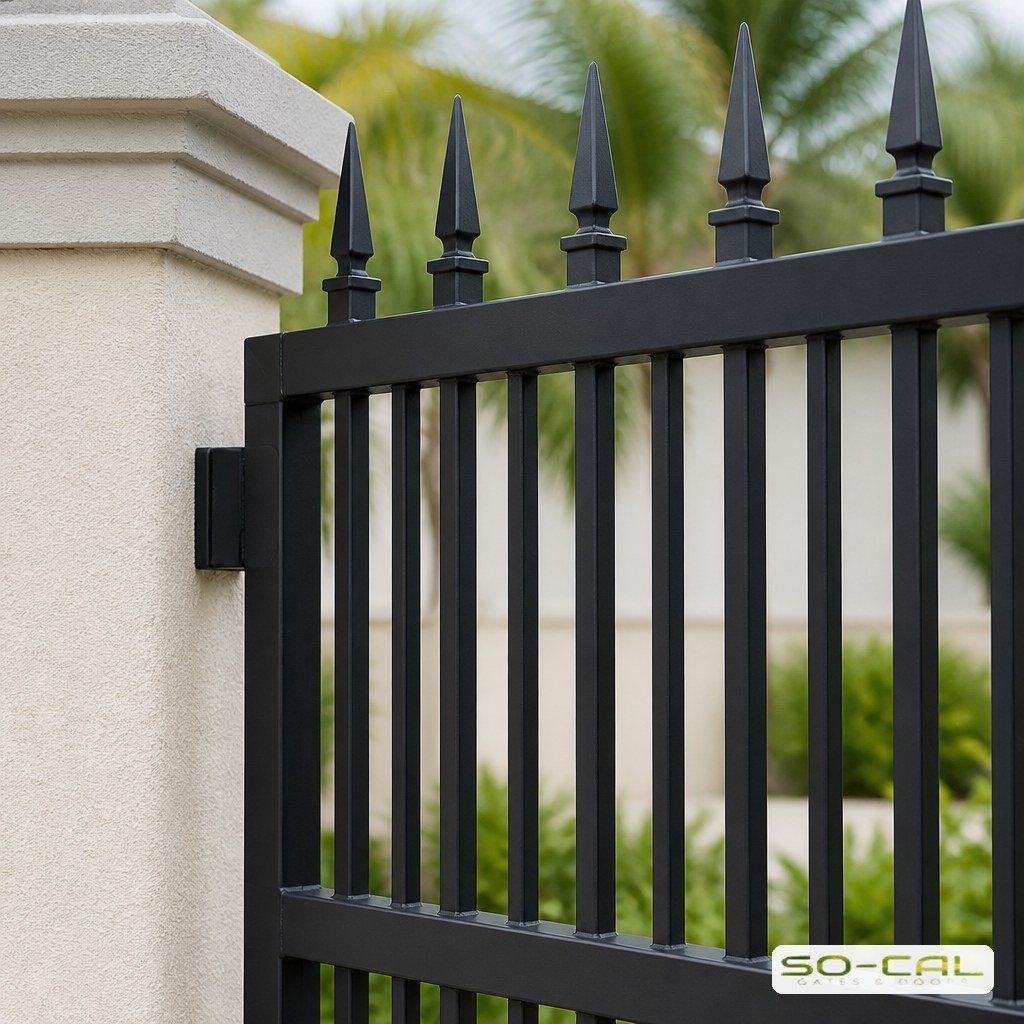
Most communities in the Inland Empire specify a palette rather than a single color, and many require that gate color relate to the home’s trim or the community standard. Material rules are usually about consistency: an ornamental metal community stays ornamental metal, and a community built around a particular look does not want a single property breaking it. Powder coating is generally preferred over paint because it holds its finish under the sun here, and a committee that has seen faded gates on its streets will often say so explicitly.
Where Submissions Usually Get Rejected
Rejections cluster around a handful of predictable issues, and almost all of them are avoidable with better documentation rather than a different design.
Vague Specifications
A drawing that says black metal gate gives a committee nothing to approve. A submission that names the exact finish, the picket spacing, the overall dimensions, and the mounting method gives them something concrete to say yes to. The more precisely you describe what you intend to build, the less room there is for a reviewer to worry about what you might build.
Height and Proportion Problems
Height is where design ambition most often collides with community standards. A gate that is taller than the wall or fence it connects to looks wrong from the street and reads as a fortification rather than an entrance. Committees notice this immediately. Designing the gate to relate proportionally to the existing perimeter is both better looking and far easier to get approved.
The Hardware Nobody Thinks to Mention
Keypads, intercoms, cameras, and operator housings are all visible, and they are the elements homeowners most often leave out of a submission entirely. A committee that approves a gate and then sees a keypad pillar appear beside it has a reasonable complaint. Including every visible component in the original package costs you nothing and removes the single most common cause of a second review round. Well-planned access control can be specified to sit discreetly within the design rather than being bolted on afterward.

How Community Type Changes the Conversation
Not every association operates the same way. The age of the community, how tightly it was originally planned, and how active the board is all change how much latitude you have. Understanding which kind of community you are in helps you calibrate your submission and your expectations.
Newer master-planned neighborhoods tend to have detailed written standards, which is genuinely helpful because the answer is usually written down somewhere. Older communities often have shorter documents and more discretion, which means precedent matters more and a conversation before submitting is worth having.
Tightly Planned Communities
Areas like Orangecrest and Dos Lagos were laid out with a coherent architectural language, and their standards reflect that. Expect specific guidance on materials and finishes, and expect it to be enforced. The upside is predictability: read the standards carefully, design to them, and approval is largely a formality.
Established Neighborhoods with Looser Standards
In more established areas such as Canyon Crest, the written rules may be shorter and the committee may rely more on judgment and precedent. Here it is worth photographing a few approved gates nearby and referencing them in your submission. Showing that your design fits what has already been accepted is often more persuasive than any argument about the design itself.
Getting Approved on the First Submission
The difference between a fast approval and a drawn-out one is almost never the design. It is the completeness of the package. Committees reject what they cannot evaluate, and they can only evaluate what you actually put in front of them.
Build the submission as if the reviewer has never seen your property and will not ask you any questions, because frequently that is exactly the case. A complete package answers everything before it is asked.
- Scaled drawing showing gate dimensions and how it meets the existing wall or fence
- Material and finish specification, named exactly, with a sample or swatch
- Photographs of the property showing the gate location in context
- Every visible component listed, including keypad, intercom, camera, and operator housing
- A reference to nearby approved installations where the standards allow discretion
Sequence matters too. Get the association’s decision before ordering materials or booking an installation date, because the architectural review is the step most likely to change your specification and the one you have least control over. An installer who regularly works inside these communities will already know what a given committee tends to ask for, and can build the submission package around that knowledge.
Conclusion: Design for the Committee, Not Around It
HOA gate rules are narrower than most homeowners expect and more predictable than they fear. Material, color, height, style, and visible hardware cover nearly everything a committee will raise, and a submission that addresses all five precisely tends to clear review the first time. Treat the association as the first step rather than an obstacle at the end, and the rest of the project follows smoothly. Contact SO-CAL Gates & Doors for a free consultation and a gate specification built to pass architectural review the first time, anywhere in Riverside or Corona.
Frequently Asked Questions
Do I need HOA approval as well as a city permit?
Frequently yes, and they are entirely separate processes. An architectural committee reviews appearance and consistency with the community, while a building department reviews structure, electrical work, and safety. Approval from one has no bearing on the other, and satisfying your association does not exempt you from any municipal requirement that applies to your project.
What is the most common reason a gate submission is rejected?
Incomplete information, by a wide margin. Vague material descriptions, missing dimensions, and unlisted visible hardware such as keypads and intercoms account for most second review rounds. The design itself is rarely the problem. A precise, fully documented package is the single most effective thing you can do to get approved quickly.
Can my HOA make me remove a gate I already installed?
Associations do have enforcement mechanisms for work carried out without approval, and the specifics depend on your governing documents. The practical risk is being asked to modify or remove work you have already paid for. Submitting first is far cheaper than arguing afterward, and it is the reason experienced installers ask about your association before quoting.
Will the HOA care about my gate opener or keypad?
If it is visible from the street, assume yes. Operator housings, keypad pillars, intercom stations, and cameras are all elements committees comment on, and they are the components most often left out of submissions. Include them in your original package with their locations and finishes, and you avoid the most common cause of a repeat review.
How long does architectural review usually take?
It varies by community and by how often the committee meets, which can be monthly rather than continuously. Because timelines are outside your control, treat the review as the first task in your project schedule rather than something to start once the design is finished. Building a realistic buffer avoids the frustration of materials arriving before approval does.
Does a gate have to match my neighbors exactly?
Usually not identical, but consistent. Most standards are written to preserve a coherent look rather than to enforce uniformity, so variation within the community palette and style is generally acceptable. Where the rules allow discretion, showing that your design sits comfortably alongside nearby approved gates is the most reliable way to make your case.