

UL 325 Gate Safety Standards Your Automatic Gate Must Meet
An automatic gate is one of the heaviest moving objects most people encounter at home or at work, and UL 325 gate safety requirements exist precisely because of that. Together with the companion construction standard ASTM F2200, they define how an automated gate must be built and how it has to behave when something gets in its way. These are not optional refinements. They are the baseline that separates a properly engineered installation from a liability sitting at your entrance, and they are worth understanding whether you are commissioning a new gate or wondering about the one you already have.
What UL 325 Gate Safety Requirements Cover
UL 325 is the safety standard for the powered operator, and its central concern is entrapment. An automatic gate has to detect that something is in its path and stop or reverse before it causes harm. The standard sets out how many independent means of protection a system needs and what kinds of protection count.
ASTM F2200 sits alongside it and governs the gate itself rather than the motor. It addresses how the gate is built so that the moving assembly does not create pinch points, shear points, or openings that a person could reach through or become caught in. A compliant installation needs both: a correctly configured operator on a correctly constructed gate. Meeting one while ignoring the other leaves a real gap.
Entrapment Protection in Practice
Entrapment protection works in layers. The operator itself provides an inherent means of detecting obstruction, typically by sensing that the gate has met resistance and reversing. That primary protection is then backed by at least one external device that detects an obstruction without contact, or by a device that responds on contact. The layering is deliberate, because any single mechanism can fail or can miss a particular scenario.
The Devices That Do the Work
Two families of external device dominate real installations, and they solve slightly different problems.
Photoelectric Sensors
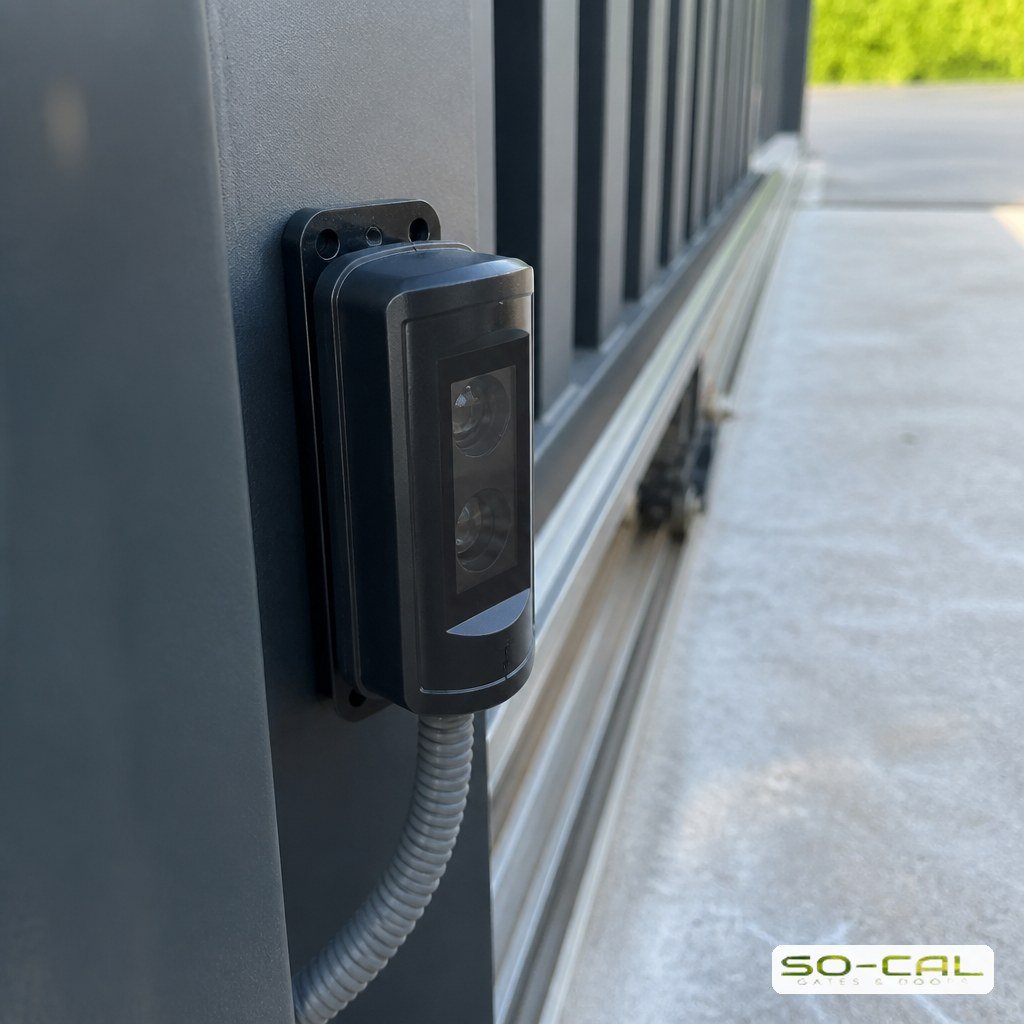
Photo eyes project a beam across the gate opening and signal the operator the moment it is broken. They are the most common external protection because they detect an obstruction before any contact occurs, which is exactly what you want when the obstruction is a child or a pet. Placement and alignment matter enormously: a sensor aimed poorly, or set at a height that misses a small child, provides far less protection than its presence suggests.
Contact Edge Sensors
Edge sensors run along the leading edge of the gate and trigger on physical contact, telling the operator to reverse immediately. They catch scenarios a beam can miss, particularly along the path of travel and at the closing edge. On sliding gates they are especially valuable, because the hazard is not only in the opening but along the entire run of the gate as it moves.
Why Dust and Sun Are a Real Factor Here
In the Inland Empire, sensor reliability is a maintenance issue as much as a specification issue. Dust films over photo eye lenses, mounting hardware shifts slightly under thermal cycling, and a sensor that was perfectly aligned in spring can be marginal by late summer. A gate that has started nuisance-reversing is usually telling you its sensors need cleaning or realignment, and treating that as an annoyance to be bypassed rather than a signal to be serviced is how protection quietly disappears. Regular attention to the sensor systems on your gate keeps the safety layer doing its job.
How the Gate Itself Must Be Built
The construction standard addresses hazards that no sensor can fully compensate for, because they arise from the geometry of the gate rather than from the behavior of the motor. If a gate creates a shear point against a post or a fence, no amount of obstruction detection makes that geometry safe.
The requirements are practical and visible once you know to look for them. Openings in and around the moving gate are limited so a hand cannot reach through into the path of travel. Exposed rollers are guarded. The gate is designed so it cannot fall from its supporting hardware or run off the end of its track. Pinch and shear points between the moving gate and fixed structures are eliminated or protected.
Gate Class and Why It Matters
Operators are classified by the kind of property they serve, from single-residence use through to industrial and high-traffic applications with unrestricted public access. The class determines the level of protection and the duty cycle expected. Fitting a residential-class operator to a busy commercial entrance is a specification failure with both a safety dimension and a reliability one, and it is more common than it should be. Correct classification is a core part of any professional commercial gate automation specification.
The Warning Signs on an Existing Gate
Older installations are where most non-compliance lives, because gates outlast standards. Missing or disconnected external sensors, sensors that have been deliberately bypassed to stop nuisance reversing, missing warning placards, exposed rollers, and a gate that can be lifted or pushed off its track are all indicators worth taking seriously. A gate that closes on an obstruction without reversing is the clearest signal of all, and it should be taken out of automatic operation until it is inspected.
What to Ask Before and After Installation
Compliance is easiest to secure at specification time and hardest to retrofit, so the questions you ask before work starts carry disproportionate weight. A capable installer will welcome them, because they are the questions that distinguish an informed client from a price-only shopper.
After installation, the same items form a sensible annual check. Safety systems degrade quietly, and an automatic gate that has been reliable for five years can have drifted well away from how it was commissioned.
- Which operator class is specified, and why it matches this property’s traffic
- What external entrapment protection is included, and where each device is positioned
- How the gate is constructed to eliminate pinch, shear, and reach-through hazards
- Whether manual release is fitted and how it works during a power outage
- What the annual service visit actually tests, not just that one is offered
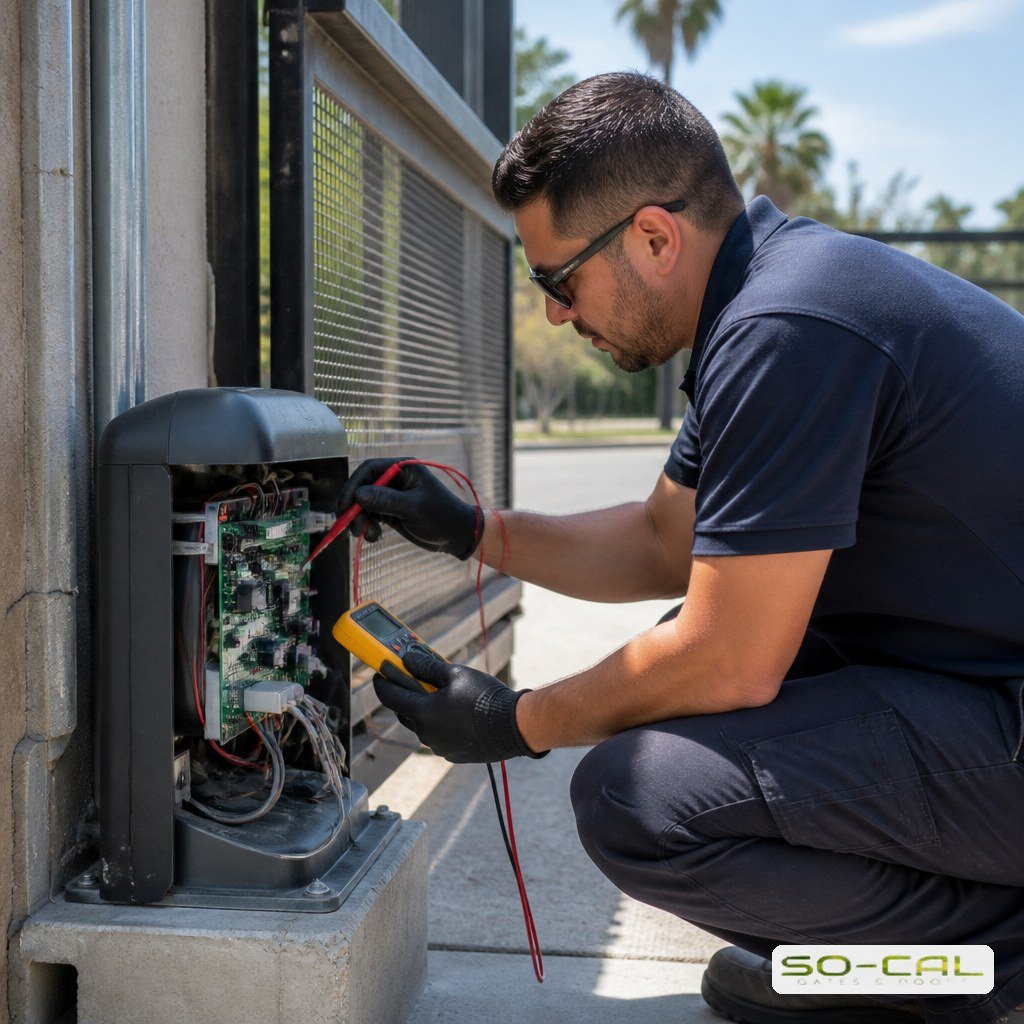
A gate motor is also a wear item, and its condition affects safety directly, because inherent obstruction sensing depends on the operator behaving predictably. A tired commercial gate motor that stalls, hesitates, or draws erratic current is not a purely mechanical problem. It undermines the primary layer of entrapment protection, which is exactly why replacement is sometimes the safety answer rather than the maintenance answer.
Conclusion: Treat the Standards as the Starting Point
UL 325 gate safety and ASTM F2200 together describe what a properly built automatic gate looks like: layered entrapment protection, an operator matched to the property, and a gate constructed without hazards that no sensor can cover. They are the floor rather than the ceiling, and any installation that treats them as negotiable is one worth questioning. If you are specifying a new gate or you are unsure whether an existing one still performs the way it did on day one, get it assessed by people who work to these standards routinely. Call SO-CAL Gates & Doors for a free safety assessment and professional gate opener installation across Riverside, Corona, and the surrounding area.
Frequently Asked Questions
What is the difference between UL 325 and ASTM F2200?
UL 325 governs the powered operator and focuses on entrapment protection, covering how the system detects an obstruction and how it must respond. ASTM F2200 governs the construction of the gate itself, addressing pinch points, shear points, reach-through openings, and how the gate is retained on its hardware. A safe installation needs both, because a compliant operator on a poorly built gate still leaves real hazards.
How many safety sensors does an automatic gate need?
The operator provides an inherent means of obstruction detection, and that must be backed by at least one additional independent means, typically a photoelectric sensor or a contact edge. The exact configuration depends on the gate type, the direction of travel, and the hazards present at the specific site, which is why placement should be determined by someone assessing your installation rather than applied from a template.
My gate reverses for no reason. Can I just disable the sensor?
No. Nuisance reversing almost always means a sensor is dirty, misaligned, or failing, and that is a maintenance issue with a straightforward fix. Bypassing the device removes a required layer of entrapment protection and leaves the gate operating in a condition it was never certified for. Have it cleaned, realigned, or replaced instead.
Does an older gate have to be brought up to current standards?
Standards generally apply at the time of installation, but that is a poor reason to leave a hazard in place. If an existing gate has missing or bypassed sensors, exposed rollers, or a reach-through hazard, the risk is present regardless of when it was built. Most upgrades are modest in cost compared with the exposure of leaving them undone, and any significant modification is a natural point to bring the installation current.
How do I know if my gate operator is the right class?
Class is determined by the property type and traffic level, from single residence through to high-traffic sites with unrestricted public access. If a residential-class operator is running a busy commercial or multi-tenant entrance, it is both a safety mismatch and a reliability problem, and the usual symptom is premature failure. A technician can confirm the class from the operator label and assess whether it suits the site.
How often should safety systems be tested?
At least annually, and immediately after any impact, power event, or change to the gate. Safety devices degrade quietly, so a gate that has run reliably for years can drift well away from its commissioned state. A proper service visit tests obstruction response, sensor alignment and function, manual release operation, and the mechanical condition of the gate and its hardware.