

Solar Gate Opener Installation in Southern California
Running mains power to a gate can be the single most expensive line on an installation quote, especially when the gate sits a long way from the house or on the far side of a finished driveway. A solar gate opener sidesteps that entirely by generating and storing its own power at the gate. In a region with this much sun it is a genuinely practical option rather than a compromise — provided the panel and battery are sized for how the gate is actually used. This guide covers how the system works, where it makes sense, what sizing really means, and what installation involves.
How a Solar Gate Opener Works
The system is simpler than most people assume. A panel charges a battery through a charge controller, and the battery runs the gate operator. The gate itself does not run on sunlight directly — it runs on the battery, and the panel’s only job is to put back what the gate used.
That distinction matters, because it means performance depends on the relationship between three numbers: how much energy each open-close cycle consumes, how many cycles happen per day, and how much the panel can replace in that time. Get those in balance and the system runs indefinitely without attention. Get them wrong and the gate works beautifully for a week and then starts failing in the evenings.
Where Solar Makes the Most Sense
Solar is the obvious answer when trenching for mains power would be expensive or destructive: long driveways, gates on the far side of finished paving, rural properties, and secondary or field gates where running a circuit could never be justified. It is also a sensible choice where the electrical supply at the property is already at capacity.
It is a weaker choice on a busy shared entrance cycling many times an hour, on a very heavy gate with a high-draw operator, or where the only viable panel position sits in shade for much of the day. In those cases mains power with a battery backup is usually the more dependable specification, and it is worth pricing conventional gate opener installation alongside the solar option rather than assuming solar is automatically cheaper.
Sizing: The Part That Decides Whether It Works
Almost every disappointing solar gate comes down to undersizing. The equipment is rarely at fault; the specification is. Sizing is not complicated, but it does require honesty about usage.
Counting Cycles Honestly
A cycle is one open and one close. A household with two cars leaving and returning, plus a delivery and a visitor, can easily reach ten or twelve cycles a day without it feeling like heavy use. Sizing a system for six because that is what it feels like is how a gate ends up flat by Thursday. Count the realistic worst case rather than the average, and add margin for guests and deliveries.
Panel, Battery and Controller
Each part has a distinct job, and undersizing any one of them limits the whole system.
What Each Component Determines
The panel sets how fast energy comes back in. The battery sets how long the gate keeps working without any sun at all. The controller protects the battery from being overcharged or drained too deeply, which is what determines how many years it lasts.
Sizing the Panel
The panel has to replace a full day’s usage in the hours of useful sun actually available at the gate position — not the theoretical daily total. Shade from a tree for part of the afternoon, or a north-facing mount forced by the geometry of the entrance, both reduce real output considerably. This is why panel position is assessed on site rather than assumed.
Sizing the Battery
The battery covers the gap between generation and use: overnight, and through cloudy stretches. A common rule of thumb is enough capacity for several days of normal use with no charging at all, which sounds generous until a run of overcast mornings arrives. Oversizing the battery is inexpensive insurance compared with the inconvenience of a gate that stops working.
Why Heat Is the Hidden Variable Here
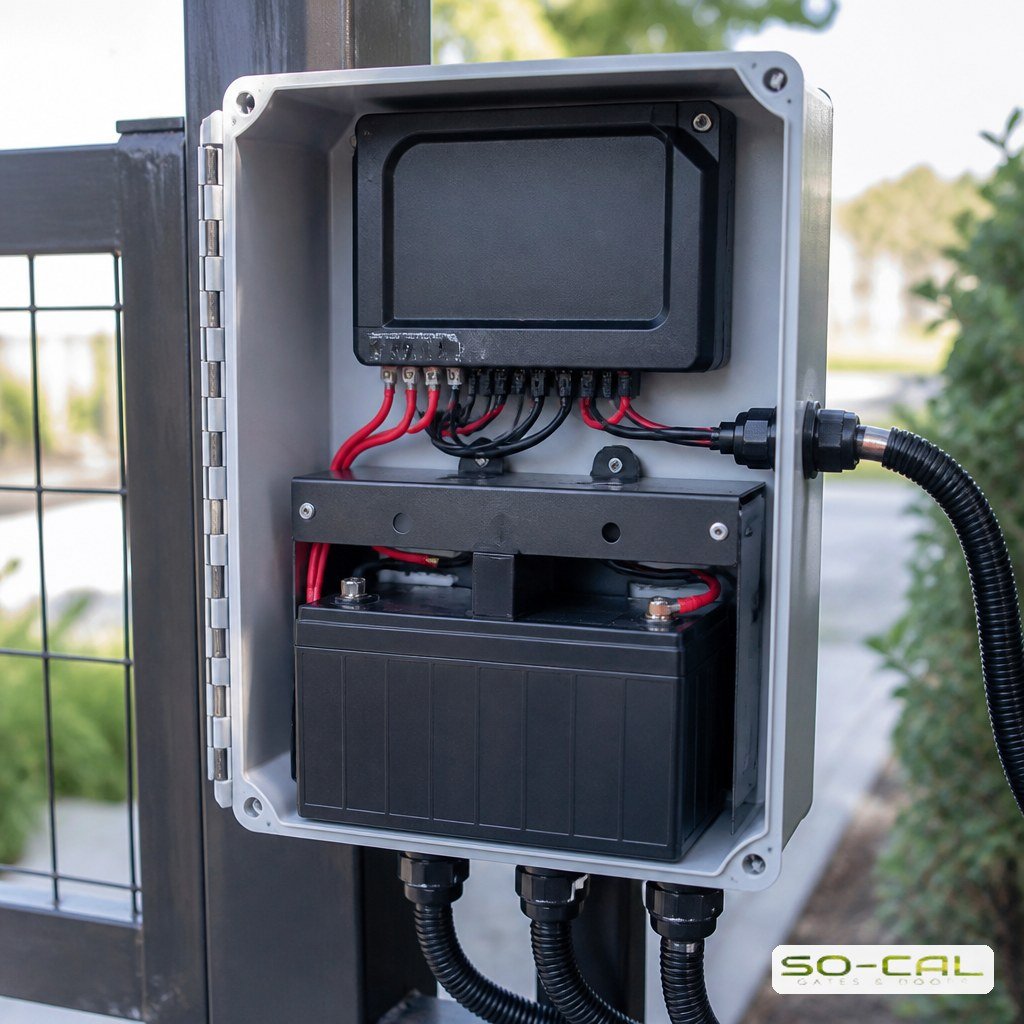
Southern California gives excellent solar generation and punishing battery conditions at the same time. High ambient temperatures shorten battery life significantly, and a battery enclosure sitting in full afternoon sun on a metal post runs hotter still. Shading and ventilating the battery box is a small detail that has a large effect on how often it needs replacing, and it is one of the clearest signs of a thoughtful installation.
What Installation Actually Involves
A solar installation has fewer trades involved than a mains one, but more site assessment. The work is mostly about position and mounting rather than about wiring.
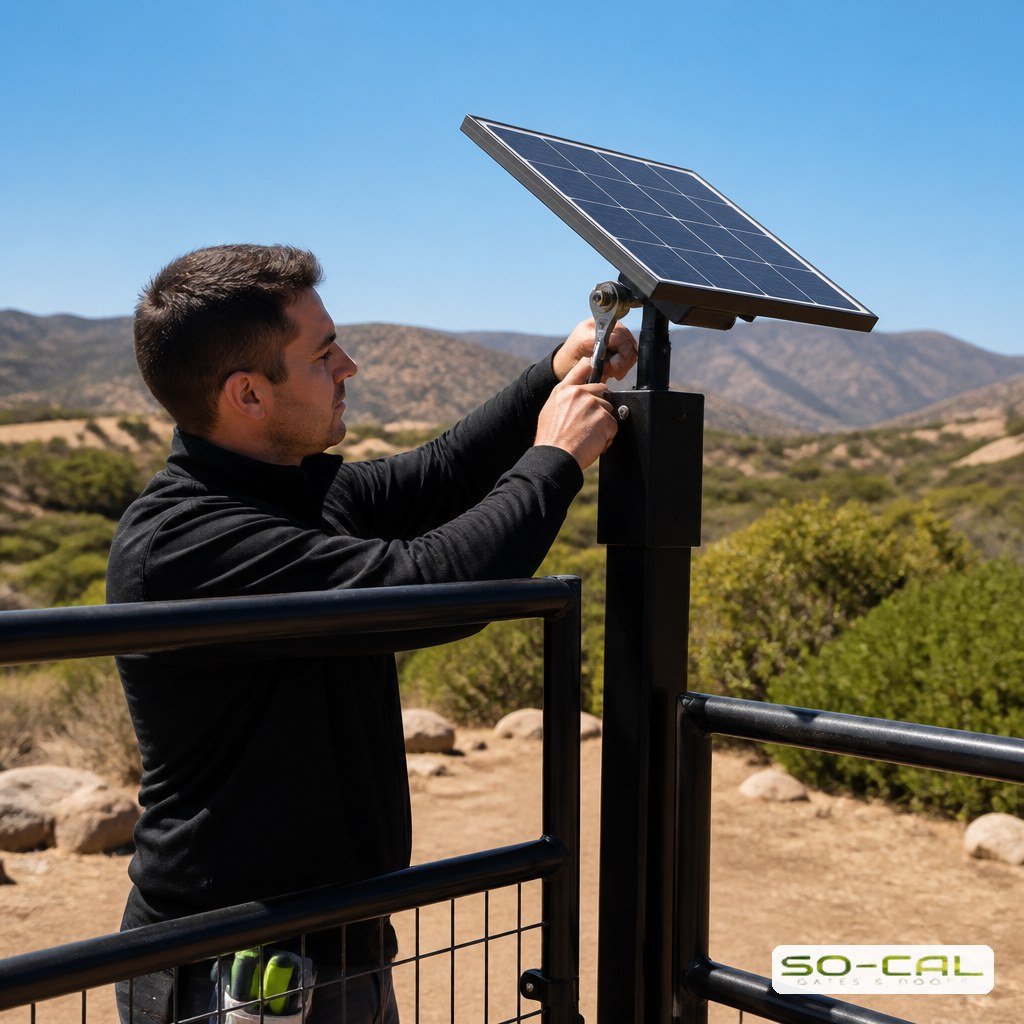
The sequence is: assess where the panel can go and what it will actually receive through the day, size the system against realistic cycle counts, mount the panel securely enough to handle Santa Ana wind loading, house the battery and controller in a weatherproof and ideally shaded enclosure, and wire the operator with the same safety devices any automated gate requires. Photo eyes and edge sensors are not optional on a solar gate any more than on a mains one, and they draw power too, which is part of the sizing calculation.
One decision worth making deliberately is what happens on a heavily overcast run or if the battery fails. Some installations keep a mains trickle charge as a backstop where a supply happens to be reachable; most rely on battery capacity alone. Either is defensible, but it should be a choice rather than something discovered in January. The same applies to any other low-draw equipment at the gate, such as electric fencing or a keypad, which all share the same power budget.
Maintenance and What to Expect Over Time
Solar gate systems are low maintenance rather than no maintenance, and the two items that matter are both simple.
The panel needs to be kept clean. Dust accumulation here is continuous, and a dusty panel can lose a meaningful share of its output without looking especially dirty — a rinse two or three times a year recovers it. The battery is the wear item, and it will eventually need replacing; how soon depends mostly on how hot it has been kept and how deeply it has been discharged. Beyond that, the gate itself needs the same annual attention as any automated gate: sensor cleaning and alignment, roller and hinge condition, and a check that the manual release still works, which matters even more on a solar system. If the gate is being newly automated rather than converted, the operator, gate and power source should all be specified together as part of automatic gate installation.
Conclusion: Size It for the Worst Week, Not the Average
A solar gate opener is a genuinely good fit for this region, and the projects that disappoint almost always share the same cause: a system sized for optimistic usage and an ideal panel position. Count cycles honestly, assess the actual sun the panel will receive rather than what the region averages, give the battery margin and shade, and treat safety devices as part of the power budget. Done that way it is a system you stop thinking about. For a solar gate opener assessed and installed properly in Riverside, Corona and the surrounding area, call SO-CAL Gates & Doors for a free site evaluation.
Frequently Asked Questions
Will a solar gate opener work through winter here?
Yes, provided it was sized for winter rather than for summer. Shorter days and lower sun angles reduce generation, so a system specified around midsummer output will struggle in December. A properly sized installation accounts for the worst month, which is why the battery is given several days of reserve rather than just overnight capacity.
What happens if the battery runs flat?
The gate stops responding to controls and has to be operated using the manual release until the battery recovers. This is why knowing where your release is matters more on a solar installation than on a mains one. A flat battery is nearly always a sizing or shading problem rather than a fault, so it is worth diagnosing rather than simply recharging.
Is solar cheaper than running mains power to the gate?
Often, and sometimes dramatically so. The comparison is not equipment against equipment but equipment against trenching. Where a long run through finished paving or landscaping is involved, solar frequently wins comfortably. Where a supply is already close to the gate, conventional power with a battery backup is usually the more economical and more dependable choice.
How long does the battery last?
It varies with type, temperature and how deeply it is routinely discharged. Heat is the dominant factor in this climate, and a battery kept shaded and ventilated will outlast an identical one baking on a sunny post by a considerable margin. Treat it as a consumable that gets replaced periodically rather than as a permanent component.
Can an existing gate be converted to solar?
Usually yes. The conversion swaps the power source rather than the gate, so the main questions are whether the existing operator suits low-voltage operation and whether a workable panel position exists. An assessment of the gate, its weight and its usage determines whether the existing operator can be retained or should be changed at the same time.
Does the panel need cleaning?
Yes, and it is the single most useful thing an owner can do. Dust builds up continuously here and reduces output well before the panel looks obviously dirty. Rinsing it a few times a year, and after any significant wind event, keeps generation where the system was designed to be.