

Custom Driveway Gates: Styles, Materials and Automation
A driveway gate is the first thing anyone sees of a property and the last line of its perimeter, which is why so many homeowners end up wanting something built rather than something bought. Custom driveway gates let you match the architecture, fit an opening that is not a standard width, and specify hardware that will still be working in fifteen years. This guide covers the decisions that actually shape the result: swing or slide, which material, what style, how automation changes the specification, and what the process looks like from first measurement to a working gate.
Swing or Slide: The Decision That Shapes Everything
Before style, before material, before budget, there is one question that determines most of what follows: which way does the gate move? Get this wrong and every later decision is a workaround.
Swing gates pivot inward on hinges, which is the traditional look and generally the less expensive option. Sliding gates travel sideways across the opening. The choice is usually made for you by the site rather than by preference.
When a Swing Gate Works
A swing gate needs clear space to open into, and it needs that space to be level. On a driveway that rises from the street, a swing gate will catch on the ground before it is fully open, which is the most common reason a swing installation disappoints. It also needs enough depth between the gate and the street that a car can wait clear of traffic while it opens. Where those conditions are met, a swing gate is simpler, cheaper, and has fewer parts to wear.
When a Sliding Gate Is the Answer
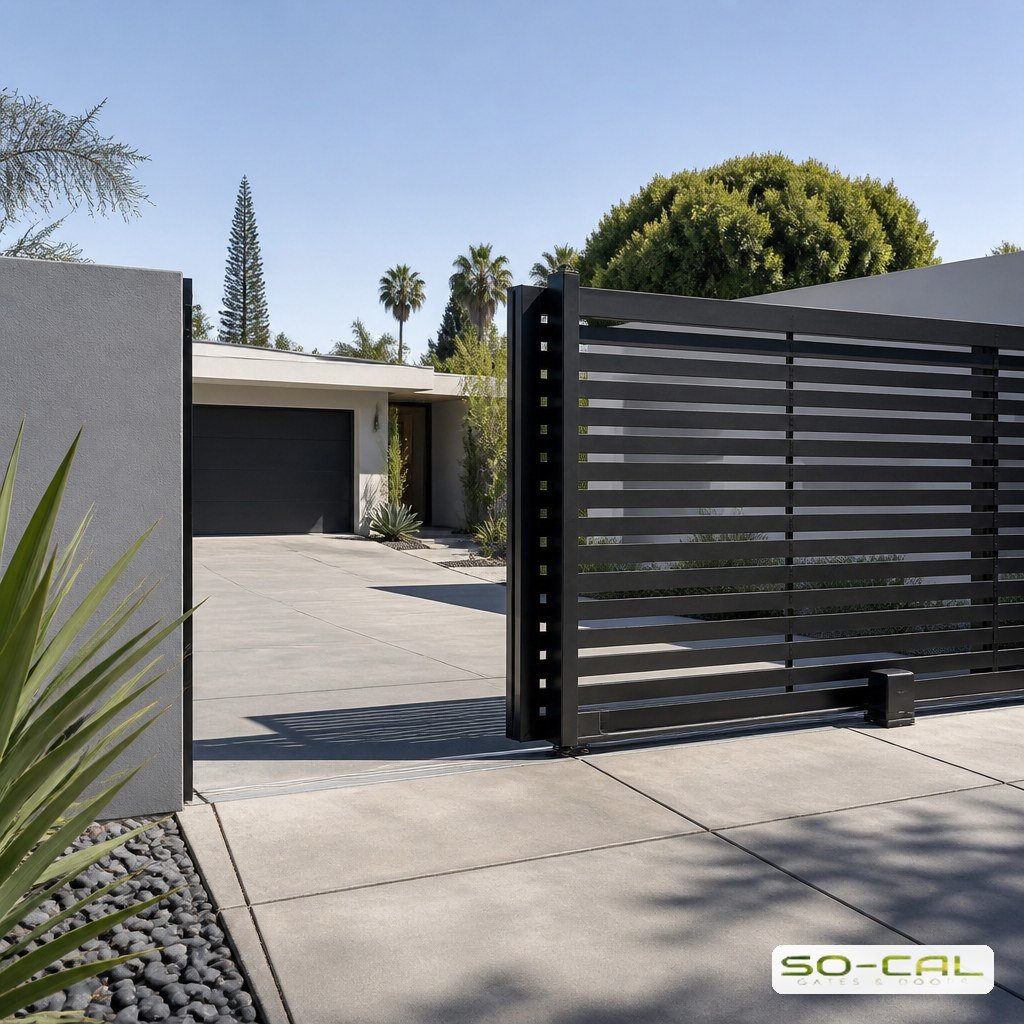
A sliding gate needs no room in front of it, which makes it the default choice on short driveways, sloped entrances, and any property where the gate opens almost directly onto the road. The trade-off is lateral space: the gate has to go somewhere as it opens, so you need a clear run alongside the opening. Cantilever designs need roughly half the opening width again in run-back, and standard sliding gates need the full width. This is the constraint that most often decides the design, and it is why professional sliding gate installation starts with measuring the run-back rather than the opening.
Materials for Custom Driveway Gates
Material choice sets the appearance, the weight, and the maintenance commitment. All three matter, and weight matters more than most people expect, because it drives the specification of the posts, the hinges and the operator.
Wrought Iron and Steel
Iron and steel are the dominant materials for custom driveway gates in Southern California, and for good reason: they are strong, endlessly customizable, repairable, and they carry ornamental detail that no other material does as well. They are also the heaviest option, and they will rust wherever the finish is broken. A properly prepared and powder-coated gate holds up for many years here; a poorly finished one starts showing rust at the welds within a couple of seasons. Matching the gate to existing wrought iron fencing is one of the more common reasons people go custom in the first place.
The Finish Is the Structural Part
On any steel or iron gate the coating is not decoration — it is the only thing standing between the metal and the weather, and how it was applied matters more than what colour it is.
Powder Coating
Powder coating is applied dry and cured in an oven, producing a hard, even, UV-stable surface that holds its colour under strong sun far better than wet paint. It is the standard for quality gate work here, and the difference is obvious after a few summers. What decides its lifespan is the preparation underneath: powder applied over poorly cleaned metal will lift regardless of how good the coating itself is.
Wet Paint and Galvanizing
Wet paint is cheaper and easier to touch up on site, which is genuinely useful for repairs, but it chalks and fades faster in this climate. Hot-dip galvanizing before coating adds a sacrificial zinc layer underneath and is worth considering on a gate that will be exposed or near irrigation, since it keeps protecting the steel even where the top coat gets chipped.
Where Rust Actually Starts
Rust almost never begins on a flat panel. It starts at welds that were not ground and cleaned properly, at the bottom rail where sprinklers hit it, and at any point where hardware was bolted through the finish after coating. When inspecting a gate — new or existing — those three places tell you more about how long it will last than the overall appearance does.
Aluminum
Aluminum does not rust, weighs considerably less, and puts less strain on the operator and hinges. It is softer than steel, so heavier sections are needed for the same rigidity, and it does not take fine ornamental work as convincingly. For modern horizontal-slat designs, and on properties where corrosion is a real concern, it is often the better answer.
Wood and Mixed Materials
Wood gives warmth that metal cannot, and it is frequently used as an infill on a steel frame — which is usually the right way to do it, since the metal carries the structure and the timber does the appearance. Solid timber gates are heavy, they move with the seasons, and under strong sun here they need real maintenance. A steel frame with timber infill is the compromise that tends to survive.
Style, Privacy and Sightlines
Style is where most of the conversation happens, and it is worth separating the visual decision from its practical consequences, because the two are connected more tightly than people realize.
An open picket or ornamental design lets you see out, lets light through, and gives wind almost nothing to push against. A solid or close-slatted gate gives privacy and blocks the view of your property entirely, but it also catches wind like a sail, which means heavier hinges, stronger posts and a more capable operator. On an exposed site that difference is not theoretical, and it is a common reason a gate that looked right on paper struggles in practice.
There is a security dimension too, and it cuts both ways. A solid gate gives an intruder nowhere to be seen from the street; an open design gives them nowhere to work unobserved and lets a camera actually see the approach. Neither is universally safer, and the right answer depends on your lighting, your sightlines and whether the entrance is covered.
Automation and What It Adds to the Specification
Most custom driveway gates end up automated, and the decision needs to be made before the gate is built rather than after. Automation is not an accessory bolted on at the end — it changes the frame, the posts and the hardware.
An automated gate has to be rigid enough that the operator is not twisting it every cycle, hung on posts and footings substantial enough to take the added load, and wired for power and safety devices. Retrofitting an operator to a gate that was never designed for one often means reinforcing the frame or resetting posts, which costs considerably more than specifying it at the drawing stage.
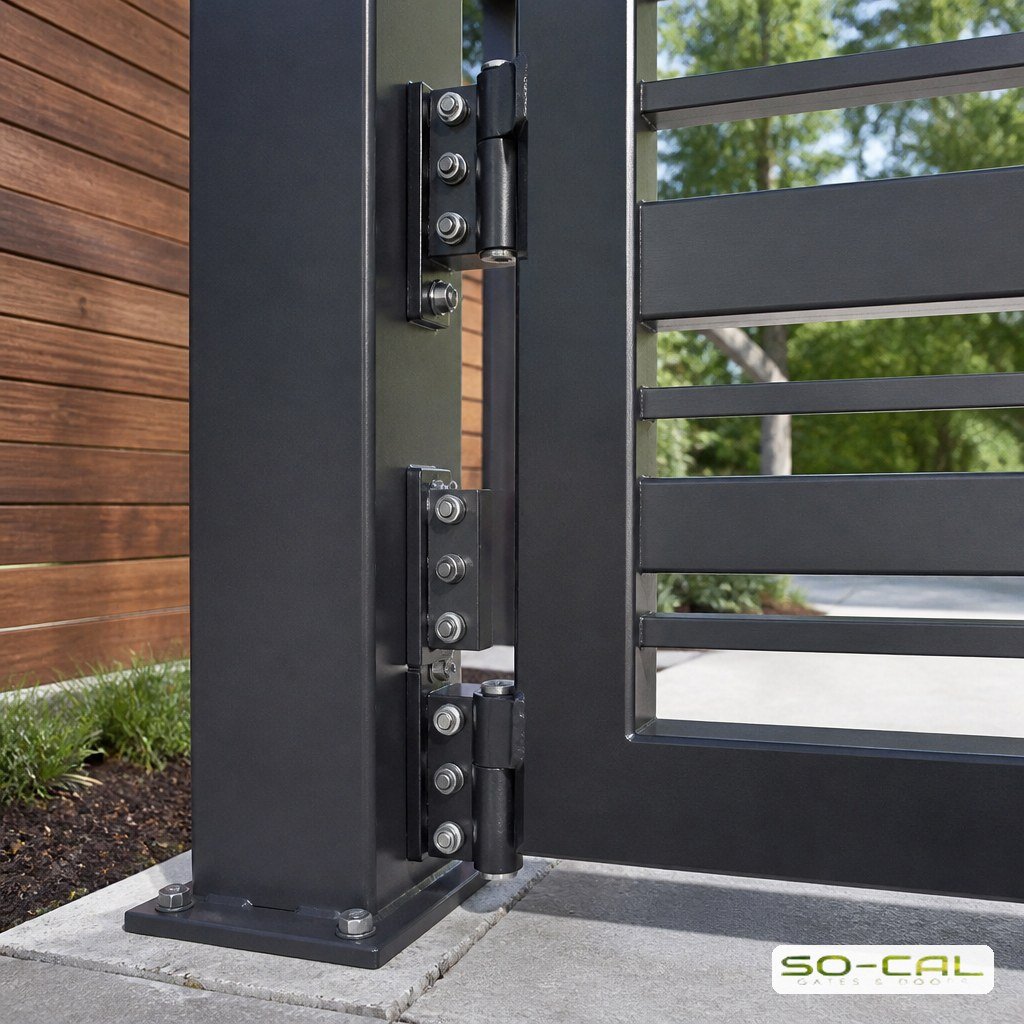
The operator itself is sized by gate weight, gate length and duty cycle, and safety devices are part of the specification rather than optional extras. Photo eyes and edge sensors stop the gate when something is in its path, and a manual release lets you open it during a power cut. If the gate will swing, the geometry of the arm and the post determines what operator can even be used, which is one more reason the swing gate installation method should be settled before fabrication starts.
Conclusion: Decide the Movement First
Custom driveway gates go wrong in predictable ways, and almost all of them trace back to decisions made in the wrong order. Settle whether the gate swings or slides based on your actual site, choose the material with its weight in mind, understand what a solid design does to wind load, and specify automation before anything is welded. Do that and the style choice becomes the fun part rather than the compromise. For a custom driveway gate measured, designed and installed properly in Riverside, Corona or the surrounding area, call SO-CAL Gates & Doors for a free consultation and an itemized quote.
Frequently Asked Questions
How long does a custom driveway gate take?
Most of the timeline is design approval, shop scheduling and finishing rather than the metalwork itself. Welding a gate takes days; waiting for drawings to be approved, for a slot in the shop queue and for the coating process takes weeks. The most effective way to shorten it is to approve the drawings promptly, since that is the stage where jobs most often sit waiting.
Is a sliding gate more expensive than a swing gate?
Generally yes, because there is more hardware involved and the operator tends to cost more. That said, on a sloped or short driveway a swing gate may not be workable at all, in which case the comparison is not really about price. The site usually narrows the choice before budget does.
Can I automate a custom gate later?
It is possible, but far cheaper and cleaner if the gate is designed for it from the start. Automation adds load, so the frame needs to be rigid enough and the posts and footings substantial enough to carry an operator. Retrofitting often means reinforcing the frame or resetting posts, which costs more than building for it originally.
What is the most durable material for a driveway gate here?
Steel and iron with a properly prepared powder-coated finish last extremely well in this climate, provided the finish is maintained where it gets chipped. Aluminum wins where corrosion is the dominant concern or where a lighter gate is needed. Timber looks superb and needs the most ongoing attention under strong sun.
Do I need approval before installing a driveway gate?
Often, and from two separate places. A homeowners association reviews appearance and will want to see the design, materials and finish. A building department is concerned with structure and any new electrical work, which typically comes into play with masonry pillars or an automated gate. The two are independent, so approval from one says nothing about the other.
How wide can a custom driveway gate be?
Wider than most people expect, but width drives everything else. As the opening grows, the frame has to resist more twisting, the posts and footings carry more load, and the operator has to be rated accordingly. Very wide openings are often better served by a pair of swing leaves or by a cantilever slider than by one enormous panel.