

Gate Fabrication: Materials, Process and Lead Times
Buying a gate off a shelf and having one built are two different projects with different costs, timelines and outcomes. Gate fabrication means a gate is designed and built for a specific opening, in a specific material, to carry a specific weight — rather than being selected from a catalog and made to fit. This guide walks through what actually happens in a fabrication job: which materials get used and why, how the process runs from measurement to installation, what drives the lead time, and when a custom gate is genuinely worth it over a prefabricated one.
What Gate Fabrication Actually Involves
Fabrication is metalwork, not assembly. A shop takes raw stock — tube steel, solid bar, aluminum extrusion — and cuts, welds, grinds and finishes it into a gate sized to your opening. Nothing about it is modular, which is both the advantage and the reason it takes longer than ordering a stock gate.
The output is a gate whose frame geometry, hinge or roller positions, infill pattern and hardware mounting points are all determined by your property rather than by a manufacturer’s standard sizes. On an opening that is not a common width, on a slope, or where the design has to match existing ironwork, that is often the only way to get a result that looks and works right.
Materials and Gauges
Material choice sets the weight, the maintenance burden and the price, and it is the first decision in any fabrication job. What most people underestimate is that the thickness of the metal matters at least as much as which metal it is.
Steel and Wrought Iron
Steel is the workhorse of gate fabrication: strong, weldable, repairable, and available in a wide range of profiles. It rusts if the finish is compromised, so the coating system is not cosmetic — it is the thing keeping the gate alive.
Tube Steel Frames
Most fabricated gates use square or rectangular tube steel for the frame because it gives high strength for its weight and welds cleanly. Heavier wall thickness resists twisting on wide openings, which is exactly where cheap gates fail — a frame that flexes will eventually stop closing squarely no matter how good the hardware is.
Solid Bar and Ornamental Iron
Solid bar is used for pickets, scrollwork and decorative elements where appearance matters and the section is short enough that weight is not a problem. It is what gives an ornamental gate its substantial look, and it is considerably heavier than tube, which feeds directly into hinge, post and operator sizing. Ornamental work of this kind sits alongside matching wrought iron fencing on most properties that use it.
Why Gauge Matters More Than Material
Two gates can be described identically on a quote and be completely different products, because the wall thickness of the tube was never stated. Thin-wall stock is cheaper, lighter and easier to work, and it produces a gate that sags and racks within a few years on a wide opening. When comparing fabrication quotes, the gauge and section size of the frame is the single most useful number to ask for, and a shop that answers it directly is telling you something about how they build.
Aluminum
Aluminum will not rust, which makes it attractive where corrosion is a concern and where a lighter gate reduces the load on the operator. It is softer than steel, so heavy sections are needed for the same rigidity, and repairs need a shop set up to weld it. For large driveway gates that see daily automated use, steel remains the more common structural choice, with aluminum making most sense where weight or corrosion is the dominant constraint.
From Measurement to Installation
A fabrication job runs through a predictable sequence, and knowing it makes the timeline far easier to plan around. Each stage has a point where a decision locks in, and changes after that point cost real money.
Site Survey and Measurement
Everything starts with measuring the opening properly: width, the level across it, post positions and condition, available run-back for a sliding gate, and where power can reach if the gate will be automated. A survey that skips the slope or assumes the posts are plumb is how a gate arrives that does not fit. This is also the stage where the operator gets specified, because gate weight and gate type determine the motor rather than the other way round.
Shop Drawings and Approval
Before any metal is cut, the shop produces drawings showing dimensions, the infill pattern, hardware positions and the finish. This is your last easy opportunity to change anything. It is also the document a homeowners association will want to see, so getting association approval against the shop drawing rather than a rough sketch saves an entire round of revisions.
Welding, Finishing and Powder Coating
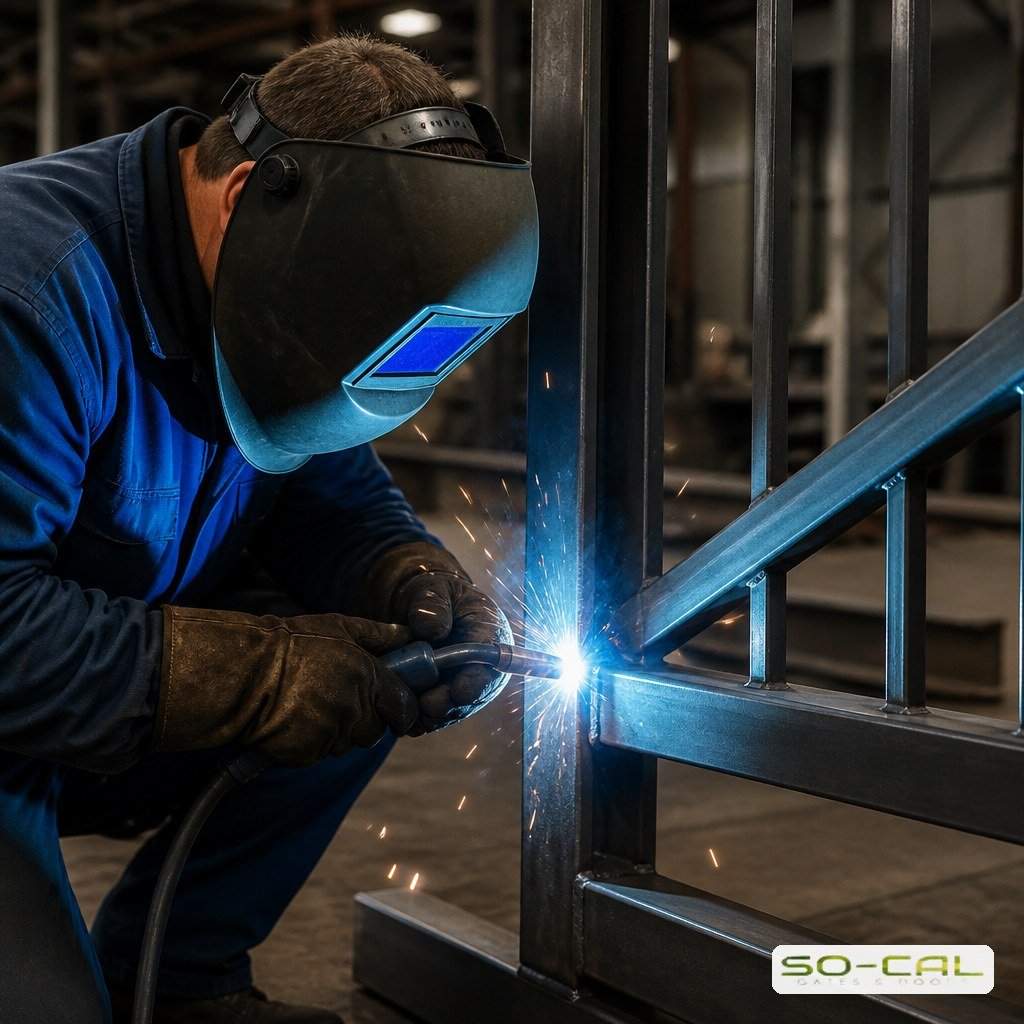
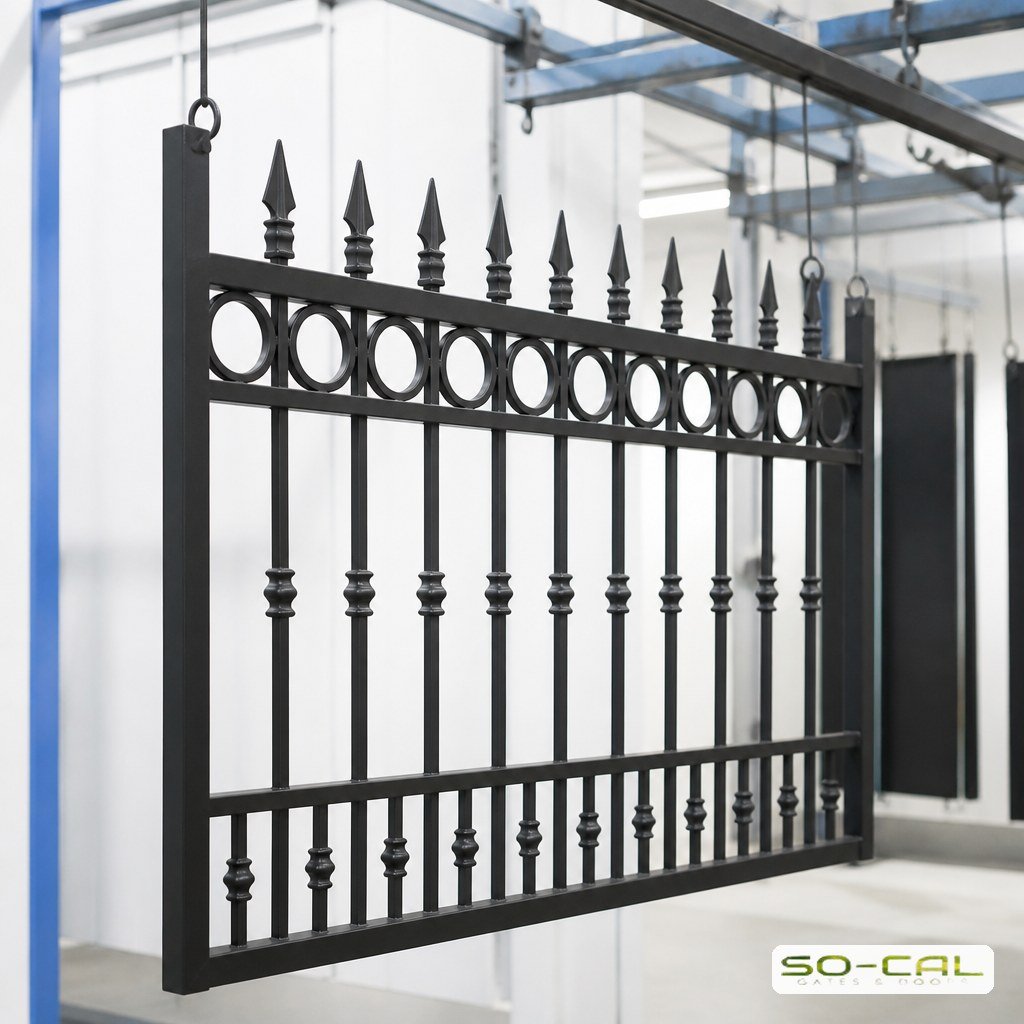
Fabrication itself is cutting, fitting, welding and grinding the joints smooth. Then comes the finish, and this is where longevity is decided. Powder coating is applied as a dry powder and cured in an oven, producing a harder and far more UV-stable surface than wet paint — which matters a great deal under Inland Empire sun, where a poorly finished gate will chalk and fade within a couple of seasons. Proper surface preparation before coating is what separates a finish that lasts a decade from one that starts lifting at the welds.
What Drives the Lead Time
Lead time is mostly shop schedule and finishing, not fabrication itself. Welding a gate is measured in hours; waiting for a coating slot, for approved drawings, or for the shop queue is measured in weeks. Custom hardware and unusual material sections extend it further. The practical advice is simple: start the process well before you need the gate, and get the drawings approved quickly, because that is the stage most often sitting idle waiting on the customer.
Custom Versus Prefabricated: When Fabrication Is Worth It
A prefabricated gate is faster and cheaper, and for a standard opening with no design constraints it is often the sensible answer. Fabrication earns its cost in specific situations rather than as a general upgrade.
It is worth it when the opening is an unusual width, when the ground slopes enough that a stock gate will not close squarely, when the design has to match existing ironwork or an association standard, when the gate needs to carry hardware a stock frame will not accept, or when the opening is wide enough that stock frame sections would flex. It is also the route for commercial sites, where gate weight, traffic volume and access-control integration rarely fit a catalog product — which is why commercial gate fabrication and the matching commercial gate installation are usually specified together rather than as separate purchases.
- Non-standard opening width or a sloped driveway
- Design that must match existing ironwork or an HOA standard
- Wide openings where stock frame sections would flex
- Commercial traffic volumes and access-control integration
- Hardware or operator mounting a stock frame will not take
Conclusion: Specify the Metal, Not Just the Design
Gate fabrication produces a gate built for one opening, in a chosen material, at a thickness that determines how it will behave in ten years. The design is the part everyone discusses and the gauge is the part that decides whether it still closes squarely. Ask for section sizes and wall thickness, get shop drawings approved early, and treat the finish as structural rather than cosmetic. For a fabricated gate measured, built and installed properly in Riverside, Corona or the surrounding area, contact SO-CAL Gates & Doors for a free consultation and an itemized quote.
Frequently Asked Questions
How long does gate fabrication take?
Most of the timeline is scheduling and finishing rather than metalwork. Drawing approval, the shop queue and the coating slot are the stages that consume weeks, while the welding itself is a matter of hours or days. The most effective thing you can do to shorten it is approve the shop drawings promptly, since that is where jobs most often sit waiting.
Is a fabricated gate stronger than a prefabricated one?
Not automatically — it depends entirely on the material section used. A fabricated gate can be built to whatever strength the opening requires, which is its real advantage, but a thin-wall custom gate is weaker than a well-built stock one. Strength comes from the specification, so the gauge and section size are the numbers that matter, not the word custom.
What finish lasts longest on a metal gate?
Powder coating over properly prepared metal outlasts wet paint by a wide margin, because it cures into a harder and more UV-stable surface. Under strong sun the difference is obvious within a few years. Surface preparation matters as much as the coating itself, since a finish applied over poorly cleaned metal will lift at the welds regardless of quality.
Can a fabricated gate be automated later?
It can, but it is much easier and cheaper if the shop knows at the drawing stage. Automation affects frame rigidity, hardware positions, mounting points and where power needs to run. Retrofitting an operator to a gate that was never designed for one often means reinforcing the frame or moving hardware, which costs more than specifying it up front.
Does a custom gate need HOA approval?
If your property is inside a community with an architectural committee, then almost certainly yes, and the approval covers appearance rather than construction. The efficient sequence is to get the shop drawing produced first and submit that, because a committee can approve a dimensioned drawing with a named finish, whereas a rough sketch tends to come back with questions.
What should a fabrication quote actually list?
A quote worth comparing states the material, the section size and wall thickness of the frame, the infill detail, the finish system, the hardware, and what is included for installation. Quotes that describe only the design and the price are not comparable to each other, because the number that most affects longevity has been left out.